


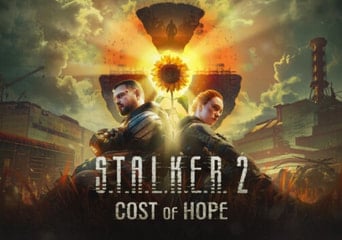


S.T.A.L.K.E.R. 2: Heart of Chornobyl
Emissions turn the sky red and send everyone to shelter, anomaly fields hide valuable artifacts, and a trip between settlements can end in an ambush. This first-person survival shooter leaves the Zone's risks to the player: gear wears down, radiation accumulates, and NPCs act on their own schedules.
Top 3 Reasons to Play
- Factions remember. Groups such as the Ward and Duty respond to what the player does, and a poor reputation can send them hunting him. Side choices feed into the story's endings.
- Feral dog packs attack soldiers and other groups without the player involved, and since Update 2.0 campfires, bus stops and similar points of interest are places that stalkers and mutants contest.
- Artifacts come with a price. The valuable ones sit inside anomaly fields, and most carry radiation alongside their bonuses. The player chooses which drawbacks to live with and which protective artifacts to wear against them.
Story and Lore
Skif is an ex-military man from the Mainland, the comparatively ordinary part of Ukraine beyond the Zone. An artifact destroys part of his home, and his search for the reason leads him past the military cordon and into the Chornobyl Exclusion Zone.
The plot begins as separate storylines that join up later, mixing factional warfare and personal vendettas with competing ideologies and gangland violence. Many of the Zone's old organisations have collapsed or turned into something new since the earlier games.
The Cost of Hope expansion starts when a mysterious PDA signal arrives during the main campaign. It follows Skif through events that run parallel to the main story, in which the D4 Treaty between Duty and Freedom begins to fall apart.
Gameplay and Mechanics
Combat is first-person, with recoil that affects movement and slow draw and reload animations. Weapons jam more often when poorly maintained, and armour loses effectiveness over time. Technicians in settlements repair gear and upgrade it, for example by reducing weight or adding artifact slots. Difficulty comes in three levels: Rookie (Story), Stalker and Veteran, where combat and anomalies are deadlier and some mutants soak up bullets.
Gunfire does not set off anomalies, so players throw bolts to trigger them before crossing. Five common types:
- Springboard: an energy wall that throws back anything touching it and deals heavy damage.
- Vortex: a dust devil that drags the player toward its core. Sprinting away can break the pull.
- Burner: a fireball that hovers in place until someone nears it, then becomes a column of flame that leaves embers burning.
- Fruit Punch: pools of radioactive waste, most often in caves, that give off toxic gas.
- Bulba: a giant bubble over water. Its pull deals damage over time, and the centre is lethal.
Artifacts form in anomaly fields and can be sold or worn. Many raise health or cut damage but add radiation, which players offset with protective artifacts such as Urchin, Slug and Slime. The Echo detector is the early-game default, and the Bear detector, sold in Rostok, finds artifacts more reliably.
Emissions announce themselves with thunder, a blood-red sky and NPC radio warnings. Caught outside, Skif's health drains until he dies, and the nearest shelter is marked automatically. Radiation shows on a gauge, bread and sausages restore health and reduce hunger, and the default carry limit is 80 kg before movement and stamina recovery suffer.
Among the mutants, psy dogs split into illusory copies of which only the real one glows, burers can force Skif to drop his main weapon, and bloodsuckers camouflage themselves before closing in for melee attacks.
Characters and Factions
- Skif is the protagonist. He knows little about his mission at the start and learns about the Zone alongside the player.
- Scar leads Spark, the faction allied with Skif, and is described as a seasoned mercenary with a checkered past.
- Colonel Korshunov commands the Ward.
- Doctor Dalin heads SIRCAA, the government's scientific research arm.
- Strelok, the legendary stalker of the franchise, appears as either an ally or an adversary.
The Zone's main groups:
- Duty is a militarised order that sees the Zone as a threat to humanity and wants it destroyed or sealed off.
- Freedom is a looser, independence-minded group that treats the Zone as something to explore and keep free of government control.
- Monolith is a zealous cult built around an alien artifact.
- Noon is made up of ex-Monolith members who broke free of the cult's mind control.
- The Ward is a highly trained military force with advanced equipment.
- SIRCAA, the Ukrainian government's research arm, has been accused of covering up human rights experiments.
- Spark opposes both the Ward and SIRCAA.
Loners work on their own, Mercenaries are professional soldiers whose purpose in the Zone is unclear, Bandits prey on travellers, the Military guards the perimeter, and the Ecologists study anomalies for the government.
Editions
The game is sold in three editions, with the Cost of Hope expansion available separately:
- Standard Edition (Heart of Chornobyl): the base game.
- Deluxe Edition: the base game with six weapons, three suits, a bonus side quest and the official artbook and soundtrack set.
- Ultimate Edition: everything in the Deluxe Edition, five more items (the Ward Exoskeleton "PSZ-21W Shturm" suit, the Rhino revolver "Model Competitor", the Viper "Monolith" SMG, the Fora-221 "Lullaby" assault rifle and the D12 "Margach D12MT" shotgun) and a Season Pass for two expansions and future DLC. Cost of Hope is one of those two expansions.
Cost of Hope can also be bought on its own and needs the base game to run.