





Overview and Introduction
Minecraft: Java & Bedrock Edition is the unified PC release by Mojang Studios that combines both primary versions of the iconic sandbox game into a single package. Released to unify the PC player base, this bundle allows players to seamlessly launch either version from the unified Minecraft Launcher without purchasing them separately.
While both editions share core sandbox mechanics, procedural world generation, and fundamental crafting systems, they are built on different game engines and serve distinct playstyles:
- Java Edition: Built on Java, this edition is celebrated for its deep modding capabilities, custom multiplayer servers, and extensive community-driven content.
- Bedrock Edition: Built on C++ (RenderDragon engine), this version focuses on multi-platform performance, cross-play compatibility, and integration with the Minecraft Marketplace.
Key Differences Between Java and Bedrock Editions
- Primary Platforms: Java Edition is available exclusively on PC systems (Windows, macOS, and Linux). Bedrock Edition runs on Windows 10/11, consoles (PlayStation 4, PlayStation 5, Xbox One, Xbox Series X|S, Nintendo Switch), mobile devices (iOS, Android), and Smart TVs.
- Game Engine: Java Edition runs on the Java Virtual Machine, while Bedrock Edition utilizes C++ powered by the RenderDragon engine.
- Cross-Play Capabilities: Java Edition supports cross-play exclusively between PC, Mac, and Linux players on Java-compatible servers. Bedrock Edition enables seamless cross-platform multiplayer across PC, consoles, and mobile devices.
- Modding and Customization: Java Edition features extensive free community mods (via frameworks like Forge or Fabric), custom shaders, and player-created skins. Bedrock Edition uses Add-ons, Behavior Packs, and official paid content from the Minecraft Marketplace.
- Graphics and Performance: Java Edition relies heavily on single-threaded CPU processing with optional shader support via mods. Bedrock Edition provides multi-threaded performance optimization and native support for DirectX Ray Tracing (RTX).
- Redstone Logic: Java Edition supports advanced mechanics like quasi-connectivity and micro-ticks. Bedrock Edition features standardized Redstone logic along with movable tile entities (such as chests attached to pistons).
Story, Lore, and World
Minecraft operates on ambient environmental storytelling rather than a traditional linear narrative. Players enter an infinitely procedurally generated sandbox comprised of diverse biomes—from lush temperate forests and arid deserts to icy tundras, deep caves, and sprawling ocean depths.
Dimensional Structure of the World
- Overworld: The starting surface dimension focused on resource gathering, base construction, and managing peaceful versus nocturnal hostile mobs.
- The Nether: A dangerous subterranean realm accessed via Obsidian portals, containing netherite, quartz, and aggressive Nether-native mobs.
- The End: A stark dimension floating in a void, housing End Cities, Endermen, and the ultimate boss encounter with the Ender Dragon.
Ancient Lore and Environmental Clues
- Ancient Cities & The Deep Dark: Hidden in the deepest subterranean layers, these structures host acoustic skulk sensors and the formidable Warden, hinting at an ancient underground civilization lost to dark forces.
- Ocean Ruins & Shipwrecks: Sunken monuments and sunken ships contain treasure maps and nautical artifacts, suggesting a forgotten maritime era.
- Strongholds & Portals: Deep underground fortresses house End Portals, connecting the Overworld to alien realms.
Gameplay, Combat, and Mechanics
Minecraft offers two primary gameplay modes that cater to different playstyles:
- Survival Mode: Players must manage hunger and health, gather raw materials, build shelters, craft tools, and defend against hostile monsters.
- Creative Mode: Grants unlimited resources, invulnerability, and the ability to fly, allowing players to build complex structures without survival constraints.
Core Gameplay Progression
- Resource Gathering: Collecting fundamental building blocks and materials such as wood, stone, coal, and iron ore.
- Crafting & Upgrading: Synthesizing tools, armor, weapons, and advanced station utilities (Anvils, Enchanting Tables).
- Redstone & Automation: Constructing automated material farms, sorting systems, electrical circuitry, and functional mechanisms.
- Dimensional Exploration: Venturing into The Nether and The End to obtain rare endgame artifacts and defeat boss entities.
Redstone Mechanics: Redstone acts as Minecraft’s electrical circuitry system. Players can construct everything from simple automated doors to complex farms, logical gates, and functional computers within the game.
Combat & Weaponry
Combat requires tactical timing and gear management. Weaponry and defensive tools include:
- Swords & Axes: Swords deliver quick continuous strikes, while axes deal higher single-hit damage with a slower attack cooldown.
- Ranged Weapons: Bows and crossbows allow distance combat, compatible with special tipped arrows for status effects.
- Shields: Block incoming melee attacks and projectiles, essential for mitigating Creeper explosions and Skeleton arrows.
- Enchanting & Alchemy: Gear can be enhanced at an Enchanting Table or Anvil with traits like Sharpness, Unbreaking, or Mending. Brewing stands allow players to craft potions for speed, health regeneration, and fire resistance.
Main Characters, Mobs, and Factions
Unlike story-driven RPGs, Minecraft features player-projected avatars alongside distinct non-player entities:
Player Avatars
-
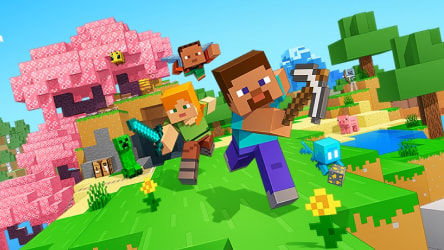
Steve & Alex: The default, gender-neutral player avatars representing the protagonist traveler in the sandbox.
Neutral & Village Factions
- Villagers: Peaceful inhabitants of scattered villages. They possess distinct professions (Armorer, Librarian, Fletcher, Blacksmith) and trade valuable resources for Emeralds.
- Wandering Traders: Traveling merchants accompanied by llamas, offering exotic flora and rare materials.
Hostile Factions & Mobs
- Illagers: A rogue faction of hostile villagers including Pillagers, Evokers, and Vindicators. They operate out of Pillager Outposts and Woodland Mansions, periodically launching Raids against player-protected villages.
- Undead Mobs: Zombies, Skeletons, and Drowned that roam dark areas and burn in direct sunlight.
- The Ender Faction: Comprises Endermen—tall, neutral beings capable of teleportation—and the Ender Dragon, guardian of The End.
Game Engine, Graphics, and Performance
The dual nature of Minecraft: Java & Bedrock Edition presents distinct graphical and hardware profiles depending on which version is executed:
- Java Engine: Utilizes Java Virtual Machine technology. It offers high customizability for shaders (via OptiFine or Iris) and graphics mods, but heavily relies on single-core CPU performance.
- RenderDragon Engine: Bedrock’s C++ engine is optimized for cross-device stability, multi-core CPU efficiency, and native support for NVIDIA GeForce RTX Real-Time Ray Tracing.
Editions, Platforms, and Bundle Content
When purchasing Minecraft: Java & Bedrock Edition for PC, players receive digital entitlements to both versions under a single MS Account.
Available Bundle Editions
- Standard Edition: Includes full access to Minecraft Java Edition and Minecraft Bedrock Edition on PC, along with the unified Minecraft Launcher.
- Deluxe Collection: Contains the base game (Java & Bedrock) plus additional digital content within Bedrock Edition:
- 1,600 Minecoins (Marketplace currency)
- 5 World Maps
- 5 Persona Items
- 3 Emotes
- 3 Skin Packs
- 1 Texture Pack