





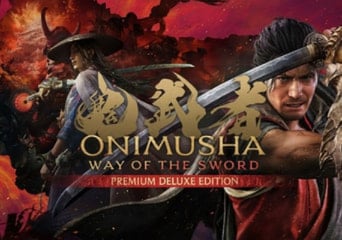


A lone swordsman crosses into a version of Kyoto the history books never recorded. Onimusha: Way of the Sword is Capcom's revival of the franchise built around a single, unforgiving idea: read an attack, hold your ground, and answer it at the exact right instant. Players take on the role of Miyamoto Musashi, a young samurai modeled on the likeness of actor Toshiro Mifune, arriving in an Edo–period capital already twisted by clouds of supernatural Malice. Genma, demonic remnants of an older conflict, roam the temples and back streets, and Musashi's only real edge against them is the Oni Gauntlet fused to his arm, a relic that lets him cut through the Genma and draw power from what's left behind.
Top 3 Reasons to Play
- A counter system with real depth: The Issen returns as a family of related techniques rather than a single move: the classic Issen rewards a perfectly timed read with a near–instant kill, Chain Issen extends that reward across a whole group of enemies, and Break Issen lets Musashi target specific body parts on staggered bosses for either bigger damage or extra souls. Layered on top of block, deflect, and dodge, the result is a defensive toolkit where each option asks something different of the player.
- Craftsmanship built on research: Capcom's team consulted with officials at the real Kiyomizu–dera temple to keep its in–game depiction grounded, and spent roughly two years negotiating with Mifune Productions to license Toshiro Mifune's likeness for Musashi. Combat hits land with vector–based cutting technology, so a sword strike carves through an enemy differently depending on exactly where and how it connects, instead of playing the same canned animation every time.
- A full campaign with room to keep playing: The development team has targeted roughly 20 hours for a complete playthrough, mixing linear story stages with open, explorable sections and side objectives. Finishing the story unlocks New Game Plus and an unlockable Carnage difficulty for players who want to push the combat system further.
Setting & Story
Edo–period Kyoto anchors the story, reshaped by a supernatural corruption called Malice that has opened the city to the Genma. Musashi arrives determined to prove himself with the blade and instead finds himself unwillingly bound to the Oni Gauntlet; his relationship with its power, and with the entity housed inside it, changes as the story moves forward.
- Oni Lady, a female Oni who resides within the Gauntlet and supports Musashi from inside it, occasionally appearing before him directly.
- Izumo no Okuni, a dancer who turns to Ono no Takamura for a way to fight back against the Genma after circumstances draw her into the conflict.
- Ono no Takamura, the figure Okuni seeks out, and an ally to Musashi over the course of the campaign.
- Sasaki Ganryu, Musashi's historical rival, confronted early in the story and playable as the demo's boss fight.
- Shuten Doji, an antagonist tied to the Mount Oe region later in the campaign.
- Daidara, a towering, club–wielding Genma driven by a constant, obsessive hunger.
Director Satoru Nihei has described the world, factions, and mythology as rebuilt from scratch for this entry. The story does not continue the original PlayStation 2 trilogy, and no prior knowledge of that saga or its cast is needed to follow along.
Gameplay & Mechanics
Combat rests on three defensive pillars: block, deflect, and dodge, each trading differently against incoming attacks. Landing a deflect chips away at enemy stamina while opening a window to strike back; a well–timed dodge sets up the series' signature Issen, a single counter–strike thrown the instant before a blow connects. Weaker Genma can fall to one clean Issen outright, while bosses take heavy damage instead. Chain Issen turns that same read into a group–clearing counter, and Break Issen staggers tougher enemies and opens a choice between raw damage and extra souls, targeted at specific body parts. A new Grapple move handles the enemy attacks marked in blue that can't be parried, letting Musashi close the distance and throw the attacker instead of eating the hit.
Absorbed souls drive the game's economy in three separate channels. Red souls are spent on upgrades, blue souls fill the Oni Power gauge that summons the Oni Armaments, and yellow souls are released when those Armaments connect, letting Musashi absorb them mid–fight to heal. Three Oni Armaments are confirmed so far:
- A pair of blades that unleash a flurry of attacks and release yellow souls on hit, combining offense with sustain.
- Hammers that tear through enemy stamina, shields, and armor alike, hitting harder the longer their attack is charged.
- A double–bladed naginata that whirls into a wind vortex, throwing enemies back and negating incoming ranged attacks caught inside it.
Outside of combat, Musashi can activate Oni Vision to reveal nearby threats, and the campaign alternates between focused story stages and more open sections that carry their own side content, rather than the tightly linear layout of the earlier trilogy.