


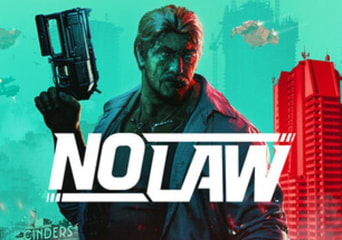

NO LAW
A first-person shooter with an RPG skeleton and immersive-sim habits, NO LAW drops the player into Port Desire, a port city that answers to no government. Grey Harker wanted nothing more than a quiet retirement from soldiering, and an attack on his home ends that plan. The game turns it into a revenge story across a city explored entirely on foot, with each building, conversation and firefight offering more than one way in.
Top 3 Reasons to Play
- Rewards ignore method. Experience points come from reaching objectives, finding secrets and moving the story forward, never from a particular technique. Picking a lock, blowing a door off its hinges and using a key pay out identically, and headshots add nothing on top. The stated intent is that stealth players never trail the ones who shoot.
- Consequences that stick: characters tied to shops, missions or the plot have jobs and home addresses, and killing one removes that person for good while the story rearranges itself around the gap. Shoot a shopkeeper and the shop shuts permanently. The studio has also shown incidents reported as newspaper articles.
- A sunlit take on neon. The setting is warm and Mediterranean-inspired, with vegetation forcing its way through asphalt and workers spraying chemicals daily to hold it back. Night and rain are part of the cycle too, bringing the neon-lit streets back. The tone leans theatrical: the developers’ shorthand for the violence is Judge Dredd.
Story and Lore
Harker left military life after near-fatal injuries on his last deployment and settled into a routine of tending plants. An organized crime outfit shatters it with an attack, and Peacekeepers arrive in time only because an informant tipped them off. In the early campaign nobody can say who that informant is, why the attack happened or what Harker has to do with it. He is handed a name and an address, and the investigation begins there.
Underneath sits a deliberately simple premise: Harker wants back what was taken from him. The depth is optional. Players who want more can talk to every character they meet, and players who do not can follow the main thread to the next target.
Port Desire occupies a no man’s land between three neighboring nations, and none of them can annex it without the other two retaliating. That standoff explains the missing legal code. Research that would be banned elsewhere is not technically illegal here, goods flow through the harbor, and the corporations and countries next door profit from the arrangement. Visitors even travel to the city for holidays, because it can supply almost anything.
- Leads replace quest chains. Several can be active at once, and when one goes cold the player has to dig through evidence to produce the next.
- Endings differ according to how Harker affects the world and which choices he makes along the way.
- Missing content is deliberate. A single playthrough cannot unlock every skill or reach every conversation, a limit the studio says it accepts.
Gameplay and Mechanics
A typical mission follows four beats:
- scour a district for clues and intel that point to a target
- get inside by climbing walls, crawling through vents or walking in through the front door
- deal with the target using stealth, action or deduction
- watch the city and the story shift according to who fell and how
Harker is a big man and the game leans on physicality. There is a kick, takedowns can be lethal or non-lethal (a guard can be choked out rather than shot), and a taser sits beside the firearms for players who prefer to leave people breathing. Being spotted mid-stealth is meant to feel like a change of plan, in the manner of a James Bond escape, and not like a failure state.
Inventory space is limited on purpose. A pistol and a shotgun commit the player to noise, while a taser and a stealth pistol, or a suppressed submachine gun, commit to quiet. Kevlar soaks up damage but wears down with every hit and occupies room that food or another weapon could have used.
Progression runs on two separate tracks. Experience points feed skill trees covering areas such as lockpicking, weapons, hacking and gear. Abilities arrive through canisters, each holding two options with only one allowed, and they slot into places tied to the body: legs, for example, take two. Roughly seven can be active at once. In the fiction they are military implants, the same ones that let soldiers wear combat armor. Movement abilities drain an energy bar that consumables refill.
There is no crafting system as such, only tinkering with explosives. Any grenade can be switched from a fuse to proximity or remote triggering, an anti-theft device lifted from a shop turns a grenade into a proximity grenade, and a thrown box of bullets goes off like popcorn when shot. Testers have also found tricks the team did not plan: one turned the effect of a smart-matter grenade, which freezes targets in mid-air and can catch the thrower too, into a way of dropping from a rooftop that is normally inaccessible.
- Daylight, darkness and weather change who is outside. Crowds thin out in the rain except in party districts, shops close at night, and residents go to bed, which leaves targets easier to catch off guard. Bars and shops also follow weekday schedules.
- Every street has a name and every building a number. By default a waypoint guides the way; an optional immersive mode removes the markers so street signs and addresses do the job.
- Walking out of a shop with unpaid goods counts as theft, and the Peacekeepers respond. A small bounty can be paid off like an administrative fee. A large one escalates to shoot-on-sight, and killing officers only raises it. A data broker, for instance, can clean the record for a price.
Density over size is the stated design principle for the city. The studio wants rooftops, balconies, alleys and the underground to hold something worth finding, and fire escapes, ladders and building facades are all part of the traversal toolkit. Optional side missions and unmarked discoveries sit alongside the main story.
Characters and Factions
Grey Harker is written as a big, tired veteran who has lived a life, and the team was explicit that he is no street punk. The references come from 1980s action cinema, a moustache was among the first design decisions, and the studio says the opening of the story follows the first John Wick film closely. Luke Roberts voices him. The writers also produced several versions of Harker’s reactions, so a contact might remark that nothing came over the radio after a quiet job, or that the noise was audible from far away after a loud one. Trailer copy says the city knows him through whispers, as an artist, a ghost, a bulldozer and a tactician; some call him The Gardener.
- Peacekeepers. Forces deployed by the neighboring nations to preserve the status quo rather than enforce conventional law. Developers describe them as corrupt and rather totalitarian in how they keep order. Gamble is named as their director.
- Gangsters and organized crime. Back-alley crews lie in wait after dark, and the underground is shadier in every sense, with residents to match.
- The Mayors. Official trailer copy names the city’s corrupt Mayors as the people Harker goes after.
- Renn. A landlord modeled on 1960s New York organized crime and film noir, who guards the informant’s building. Getting past him takes a password or a bribe, though a shotgun to the face also works.
Editions
No editions, DLC or pre-order bonuses have been announced.
PC System Requirements
Official specifications have not been published.