



Gears of War: E-Day
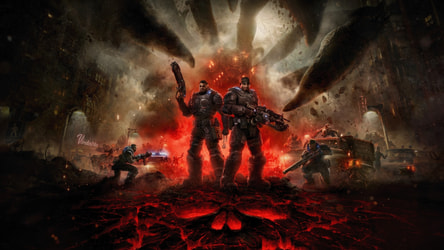
Gears of War: E-Day goes back to the start of the Locust War, an event the earlier games referred to often but never showed in detail. It is a third-person cover shooter about a younger, rawer Marcus Fenix and Dominic Santiago, thrown into an invasion with no warning while they try to keep strangers alive.
The package has two halves. A story campaign can be tackled alone or with friends, and the multiplayer side rests on Horde Siege, a large-scale co-op survival mode, and Versus, the series’ long-running competitive mode.
Top 3 Reasons to Play
- A war seen from street level - The campaign never cuts away from Bravo Squad. You learn only what its four members learn, and you witness only the parts of the invasion they stumble into. Creative director Matt Searcy has named Band of Brothers and Saving Private Ryan as the models: a planet-wide catastrophe told through one small unit that often ends up somewhere it would rather not be.
- A city that breaks under your feet - Kalona rarely keeps the same shape for long.
- Sinkholes can drag parked cars and whole structures underground in the middle of a fight.
- Cover erodes under fire, losing chunks across a range of materials.
- Emergence holes allow the Locust to surface anywhere on the battlefield. A grenade dropped inside seals one shut.
- Horror lighting on a fresh engine - Nothing here was ported from earlier entries. Every asset and animation was made new in Unreal Engine 5, and E-Day is one of the first games to ship with MegaLights, a lighting system that lets artists place hundreds of shadow-casting lights in a single scene. The Coalition used it to lean into the horror the original games only flirted with, with stronger contrast and much darker interiors.
Story and Lore
Sera is at peace for the first time in almost eighty years. With the Pendulum Wars over, Marcus and Dom are back in Kalona for an armistice memorial, trying to work out what life looks like without a rifle. Things between them are strained. Carlos Santiago, Dom’s older brother and Marcus’s best friend, died at Aspho Fields shortly before the ceasefire, and his absence hangs over the whole campaign. Readers of Karen Traviss’s novel Aspho Fields will recognise that backstory; Traviss consulted with the studio on E-Day’s narrative.
Then the ground opens.
The events take place fourteen years before the original Gears of War, and the action stays inside Kalona from start to finish. The city is fictional, an industrial centre whose fortunes grew out of decades of wartime Imulsion production, with refineries, a working waterfront, an airfield and a sports stadium ringed by residential blocks. Lit windows and abandoned dinners show it was a functioning home minutes before the attack.
Three days pass over the course of the story, and each one carries its own tone:
- Night one is confusion and fear. Nobody understands what is crawling out of the streets, let alone what to call it.
- Day two is about regrouping: the survivors link up with the military and start running missions as a squad.
- Day three brings desperation, once it becomes obvious the attack is happening everywhere on Sera.
Gameplay and Mechanics
Movement and cover
Cover still anchors every encounter, but the system underneath it was rebuilt. Transitions in and out are smoother, cover comes in more heights and shapes, and a new low-ground type spreads fights across uneven terrain. From a sprint you can slide under obstacles or straight into cover. Jumping is possible for the first time in the series, too, although the developers have said it exists for gaps and flanking routes rather than platforming.
Missions alternate between tight street fights and open districts where an objective can be approached head-on, through a side entrance or from a balcony across the road. Optional encounters include rescuing trapped civilians, and according to the studio this campaign hides more collectibles than any it has made, COG tags among them.
Weapons and reloads
- Gnasher: the returning close-range shotgun.
- Longshot: a sniper rifle that rewards patient positioning.
- Gut Puncher: a new grenade launcher firing armour-piercing explosive rounds. Tap to have them burst on their own, or hold the trigger to set off the blast behind an enemy’s cover.
- Incinerator: a new Imulsion-fuelled shotgun that burns through targets at short range.
Active Reload is back with a reworked interface, and some weapons load shell by shell, which means a reload can be cancelled to fire before the magazine is full. A new gore system handles localised damage, from chunks torn out by rifle rounds to limbs removed by heavier guns, while blood and grime build up on characters as a fight drags on.
Horde Siege
Horde debuted in Gears of War 2 as a five-player wave-survival mode. Horde Siege scales that idea to 12 players split into three squads of four, each pursuing its own mission on one large map of Kalona. Squads cross paths, can team up on shared objectives and world bosses, and may find fortifications left behind by a team that has already extracted.
The classes available at launch are Assault, Marksman, Medic and Breacher, each with its own starting loadout, combat bonuses, Tactical Gear and progression track. Surviving a mission earns rewards that unlock customisation and improve the loadout for the next run.
Versus
Competitive play sticks with the classic 4v4 format on maps set in and around Kalona. Core modes include:
- Team Deathmatch, where each side works through a limited pool of respawns.
- Conquest, a King of the Hill variant whose scoring zone remains active instead of relocating.
- Demolition, in which teams take turns planting and defusing bombs.
- Crucible, which awards points for holding a Power Core inside a zone.
Ranked playlists bring placement matches and skill ratings. Social offers quick play along with matches against bots for anyone easing in.
Characters and Factions
Bravo Squad forms almost by accident. When a road splits and Wretches pour out, four off-duty Gears in civilian clothes run toward the danger rather than away from it. Any of the four can be picked from the opening chapter.
- Marcus Fenix (John DiMaggio): home from the war with no clear next step, younger and far more vulnerable than the hardened sergeant of the trilogy.
- Dominic Santiago (Carlos Ferro): a husband and father of two. DiMaggio and Ferro have voiced the pair since the 2006 original.
- Mags Carter (Elizabeth Ludlow): a former Gear, dishonourably discharged, now working at Kalona’s Imulsion refinery and openly sceptical of the COG.
- Lucas Reyes (Jake Ryan Lozano): a cadet and communications officer who wanted front-line duty and never got it. He and Mags are Kalona locals and serve as the squad’s guides to the city.
Tai Kaliso (Maateiwarangi Heta-Morris), the South Islands warrior known from Gears of War 2 and the comics, fights alongside Theta Squad. His arrival is tied to the birth of the Chainsaw Lancer, which begins life as a prototype assembled on the front line.
The COG
The Coalition of Ordered Governments is the state and army Bravo Squad ends up fighting for. Its soldiers enter the invasion with no intelligence on the enemy and no doctrine for fighting it.
The Locust Horde
Searcy has described the opening as something close to a zombie film, until it dawns on everyone that the creatures have commanders and structure. The squad invents nicknames for each new monster on the spot, and those improvised labels are the ones that stick for the rest of the series. Each new arrival raises the stakes:
- Feral Wretches surface first, animal-like and deadliest in numbers.
- Drones follow, and the discovery that they carry weapons and talk is what turns a monster outbreak into a war. They were redesigned to look far more formidable than the cannon fodder of the early games.
- Boomers, Corpsers and Reavers come back as heavier threats, joined by new creatures from the Hollows below the surface.
Editions
All editions contain the same full game. The higher tiers add cosmetic content, and the Collector’s Edition adds physical extras.
Standard Edition
Campaign, Horde Siege and Versus with nothing added. Copies bought through the Microsoft Store are Xbox Play Anywhere titles, covering Xbox Series X|S and Windows PC with one licence and shared progress.
Premium Edition
- Bravo Squad Signature Weapon Pack
- Five Seasonal Customization Packs, beginning with the Emergence Pack
- 1,000 Iron, the premium in-game currency
Standard owners can add the same content later through the Premium Edition Upgrade.
Collector’s Edition
This box bundles the Premium Edition content and an Emergence Omen weapon skin, with the game on disc for Xbox Series X or as a Steam code on PC. The physical items are:
- A 15-inch statue of Marcus catching a falling Dom inside a collapsing building, lit by a battery-powered red glow from an E-hole below
- Zinc-alloy replica COG tags engraved for Carlos Santiago
- A replica of the in-game photo of Dom, Carlos and Marcus
- A SteelBook case illustrated by Luke Preece
- A Feral Wretch art print in a portfolio case, plus a thank-you note from the team
- Display packaging with a built-in drawer for the tags