




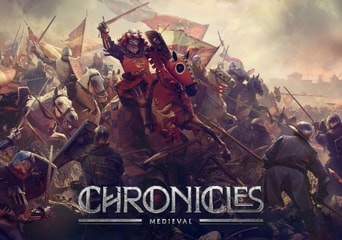

Chronicles: Medieval
Chronicles: Medieval puts you in 14th-century Europe as a nobody with almost nothing to your name. Where things go from there is your call. Villages and towns offer work, camps hold men willing to fight for coins, and every victory adds weight to your name until you are strong enough to challenge the lord of an entire region.
Raw Power Games blends action and strategy here: you are expected to lead an army and fight inside it. The game is being built in the open, too, with the studio expanding it through Early Access based on player feedback.
Top 3 Reasons to Play
- Command and fight in the same battle. Total War keeps you as a camera floating above the field, while Mount & Blade II: Bannerlord puts you in the saddle among your troops. Here you get both in one engagement: deployment takes place from an overhead view, and the fighting itself from horseback, or on foot if you dismount. Should you fall, the battle carries on without you, and the men who see you go down lose heart.
- A period piece built on research. Kit and uniforms are matched to region and troop type, and the studio brought in HEMA (Historical European Martial Arts) specialist Björn Rüther to give melee its weight.
- Reputation with real consequences. Executing a defeated commander may get you land and resources sooner. People notice, though, and a ruthless reputation closes doors that a merciful one keeps open.
Story and Lore
History provides the backdrop rather than a script. The Hundred Years' War, fought between the English and French crowns from 1337 to 1453, shapes the politics of the map, and the team researched the era in depth. It isn't a reenactment, though. The period supplies the conditions, and what happens within it is down to you: there is no fixed protagonist and no main questline to follow.
Exploration takes in three broad regions – the British Isles, France and the lands of the Holy Roman Empire.
Instead of one endless campaign, play is divided into historical chapters. Each chapter is a separate starting scenario with its own political and economic situation, and more of them are slated for the Early Access period. One showcase battle gives a sense of the texture: an Imperial army squaring off against France's Valois forces in the hills of Burgundy in 1347.
A routine ride between towns can still turn into a fight, since enemy patrols roam the landscape. The balance of power between factions shifts too, whether or not you take part.
Gameplay and Mechanics
On the campaign map
Outside of combat you travel a large overworld, stopping at settlements and dealing with the people there. NPCs hand out jobs such as clearing bandit camps, while alliances and trade routes open up the resources a growing force depends on. Recruitment takes place in these settlements as well, and every new soldier adds to the bill: troops expect regular food and pay, and morale sinks when either runs short. Neglect it long enough and men start deserting.
Castle building is part of the design too. Higher castle tiers and more advanced siege engines are tied to later chapters on the way to 1.0.
On the battlefield
Every engagement opens with a planning stage:
- Deployment. An overhead view lays out your staging area. Units can go anywhere inside it, and you can mark their paths or assign flanking routes before the first arrow flies. Nothing forces your army into a prescribed shape.
- Formations. Previews have shown wall, wedge, column, diamond and mixed setups. Any of them can backfire in the wrong situation, and slow reformation punishes a badly timed switch.
- Morale and cohesion. Casualties, a charge into a unit's flank or the sight of a neighbouring unit routing all wear morale down. Cohesion is tracked separately and reflects training, with household troops who have fought together for years holding firmer than peasants in their first battle.
When the fighting starts, orders come from inside the melee rather than from a menu: advance, hold, engage, charge or fall back. Units close to you respond directly, but distant ones have only flag signals to go on. Played manually, a full battle runs roughly 10 to 15 minutes, and fights you'd rather skip can be simulated instead. Anyone who finds a HUD out of place in a medieval scene can switch the battlefield UI off entirely.
Expect a steep learning curve at first. Raw Power Games has said onboarding and tutorials won't be complete when Early Access opens and are due for improvement before 1.0.
Characters and Factions
Your character is created from scratch, with no noble pedigree to fall back on. One demo showed the commander carving through enemy ranks with a poleaxe to steady troops on the verge of breaking. Every fight you take part in feeds your progression, and soldiers who survive a battle earn experience of their own and can move along their unit's upgrade path.
England, France and the Holy Roman Empire are the three playable powers, each fielding its own historical units. Their armies deploy by doctrine as well as by unit type:
- England – longbowmen gravitate to the flanks, where they can shoot unobstructed.
- France – heavy cavalry moves up to the vanguard, true to its historical role as the spearhead of an attack.
- Holy Roman Empire – heavily armoured infantry, polearm troops among them, packs into a dense vanguard and middle guard for opponents to wear themselves out on.
Men-at-arms and crossbowmen round out the rosters, and more factions are on the way.