

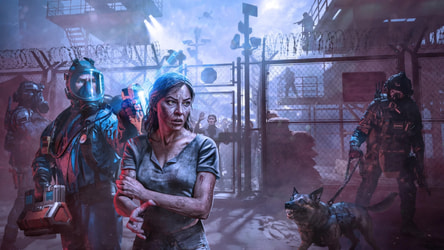


Quarantine Zone: The Last Check
Brigada Games built this simulation around one job: manning the gate of a survivor compound during a zombie outbreak and deciding who gets inside. Devolver Digital published it. Every arrival is checked for fever, wounds, odd reflexes and forbidden goods, and each verdict has consequences that reach into the next day.
Back inside the walls, food, fuel, power and medicine have to reach a growing population, and attacks on the perimeter are answered from the controls of an armed drone.
Top 3 Reasons to Play
- Cases that do not repeat. Symptoms, survivor traits and carried items are randomized, and the same day plays out differently on a second run. A wrong call costs money or lets an infected person into the survivor block.
- A toolkit that grows with the job. Early inspections rely on little more than a flashlight and a thermometer. Progress brings new instruments and weapon upgrades, and the scanner can separate a harmless bruise from a bite mark.
- Side requests with odd targets. Wanted notices on the bulletin board turn routine inspections into small hunts: a chocolate bar hiding infected tissue, a Molotov cocktail packed among lemons in a girl's backpack.
Story and Lore
The outbreak has pushed the city to the point of collapse, and the player assumes the post at the gate of a quarantine zone. Reviews describe an opening with a helicopter arrival and a briefing from a drill-sergeant-style major, after which the player becomes the compound's main inspector. Quarantine Zone casts the player as a government agent in charge of a key checkpoint, and each decision there comes at a moral price.
The virus keeps mutating, and new symptoms have to be studied as the campaign goes on. Arrivals come with excuses, such as a bite blamed on a dog, and the game does not soften the outcome when an excuse proves false. The campaign closes with a good or a bad ending, depending on how well the evacuation quotas were met.
The free Miami Zero update moves the story back to the first days of the outbreak in Miami, Florida, and hints that the outbreak may not have been an accident.
Gameplay and Mechanics
Each in-game day starts with a queue at the gate. The player studies a person's documents, belongings and body, then chooses a destination: the survivor block for those who look healthy, a quarantine ward for ambiguous cases, or liquidation for definite infection. Bite marks and necrosis settle a case at once, bruises and freckles are harmless, and signs such as conjunctivitis or a raised pulse land in the gray zone. Quarantined arrivals are re-examined after a night or two. Some turn in the meantime, and everyone sharing the ward is at risk. Correct verdicts earn money and research points; mistakes such as liquidating a healthy survivor bring fines.
Instruments arrive gradually and can be upgraded:
- Flashlight and thermometer for eye color and body temperature.
- A reflex hammer and a stethoscope, for nerve response and breathing.
- A scanner that sees through clothing to bruises, rashes and bite marks.
- A portable X-ray that shows internal organs and anything hidden inside the body.
- The metiascope, an eye-inspection device.
- A limited-use infection syringe that gives a definitive answer.
Contraband is a second layer of inspection. Arrivals bring forbidden items in bags and pockets, and later in the campaign they start hiding them inside their own bodies, where only the X-ray finds them. Not every confiscation is welcome: some bulletin board requests ask the player to leave an item alone, such as flamethrowers owned by farmers who burn the dead.
The laboratory covers what the instruments cannot explain. A survivor with unknown symptoms can be sent there for a timed organ-extraction minigame that reveals a new symptom for the inspection manual. A cage on the grounds holds newly turned zombies; samples taken from them pay for new tools, level up staff and fund longer-term upgrades, and corpses fed to the cage bring a government payout.
Base management runs through a tablet: beds and food for survivors, fuel and generators for the buildings, medkits for the clinic, restock orders. Supplies are also wheeled in on a cart of limited capacity, and anything overloaded falls off.
When alarms sound, the player takes control of a weaponized combat drone with upgradable armament and shoots down infected approaching the walls or dropping in from rooftops.
Evacuation days break the routine. Trucks leave with a fixed number of seats, some with restrictions on who may ride, and the player decides which uninfected survivors board and then covers the convoy with the drone. The campaign spans roughly 25 in-game days, and Endless Mode continues the loop once the story is over.
Characters and Factions
Survivors are generated from randomized traits, and the recurring figures are few.
- The Major. The player's superior, an unnamed officer who briefs the player and hands down orders.
- Solomon. A man with a death record who appears in the queue as the target of a bulletin board request. His first name stays fixed between playthroughs, while his surname and appearance change.
- Survivors. Ordinary arrivals, each with documents, belongings and an explanation for their condition.
- The infected. Zombies at the walls, in the cage and, after a failed quarantine, inside the ward itself.
The Miami Zero update brings a new cast of eccentric survivors.
Editions
The base game holds all gameplay content; every add-on is cosmetic or audio.
- Standard Edition: the base game.
- Deluxe Edition: a Steam bundle of the base game, the Soundtrack, the Supporter Pack and the Miami Supporter Pack.
- Soundtrack: the official score by composer Dawid W. Mika, supplied as MP3 and higher-quality WAV files.
- Supporter Pack: a cosmetic add-on with a new command room interior and new skins for three of the tools used to defend the base. It gives no gameplay advantages.
- Miami Supporter Pack: a second cosmetic pack; the store page does not itemize its contents.