



Forza Horizon 6
Playground Games sent its open-world racing series to Japan for the sixth mainline Horizon entry, released May 19, 2026, on Xbox Series X|S and Windows PC through Steam, the Xbox app, and Xbox Game Pass. A PlayStation 5 version follows later the same year as its own separate release, and Horizon 6 is also the first entry in the series to drop Xbox One support.
Japan and the Horizon Festival
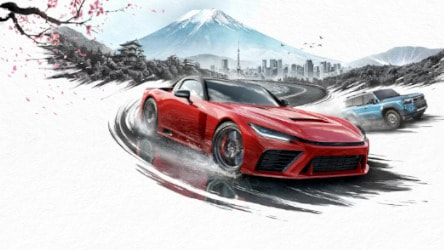
The setting has been requested since at least Forza Horizon 4, and the map delivers on it: Tokyo City's high-rises give way to touge passes through Mt. Haruna and Bandai Azuma, with roads pulling from real routes like the C1 loop and Gingko Avenue. Tokyo City on its own is Horizon's largest urban environment to date, about five times the size of Forza Horizon 5's Guanajuato, set against coastline, farmland, and mountains that hold snow year-round for anyone who wants an excuse to run winter tires in July. All four seasons carry their own weather and soundscape.
- Players start as a tourist rather than a returning champion; the opening Horizon Qualifiers introduce two characters covered further down.
- Progress runs through seven Wristbands, each earned by clearing a Wristband Event: a classic Horizon Showcase or one of the new Horizon Rush obstacle courses, including one at the Tokyo City Docks.
- Hypercars stay out of official Festival races until the Purple Wristband, though there's nothing stopping players from driving one in Free Roam from day one.
- The Gold Wristband unlocks Legend Island, home to its own circuit and the Colossus, a Goliath race that loops the entire map.
Running alongside the Festival is Discover Japan, built around Stamps instead of Wristbands: photography, food-delivery side jobs, car collecting, and Horizon Stories all count toward one. Stamps unlock Player Houses with their own Customizable Garages, Barn Find rumors, and access to The Estate, an empty mountain valley players can shape with the EventLab toolset.
Gameplay and Mechanics
More than 550 cars are on offer at launch, weighted toward the kei cars, vans, and JDM classics that define Japanese car culture. Car classes have been rebalanced across the board, and a new R Class caters to track-focused builds.
Customization runs deeper than in past entries: Forza Aero is now configured per car rather than sharing one front-and-rear setup across the whole roster, the livery editor can finally paint windows, and more than 100 additional rims can be mixed front and rear. Select cars take body kits from Liberty Walk, Rocket Bunny, and Origin Lab, kei cars can be fitted with motorcycle engine swaps, tires pick up cosmetic wear as the miles add up, and steering-wheel animation now turns through 540 degrees.
Beyond buying cars outright, Playground has added two ways to find them on the road: parked Aftermarket Cars near race restrictions or Time Attack circuits, and Treasure Cars, abandoned vehicles tracked down using a photo clue from Mei. Barn Finds are back too, their clues handed out as Stamp rewards. Wheelspins, including Super Wheelspins, now arrive every three levels instead of every one; Playground calls it a deliberate rebalance, not a bug.
New Faces and Car Culture
Two characters meet players on arrival: Jordy, a fellow newcomer with a motorsports background, and Mei, a Japanese car builder who provides cultural context and the photo clues behind Treasure Cars.
- Car Meets now run inside the Shared Open World at three fixed spots: the Horizon Festival Site, the alpine Okuibuki Parking Lot, and a Tokyo recreation of the real Daikoku meetup, plus rotating temporary meets through the live Festival Playlist.
- Drag Meets and Time Attack Circuits both live in the same Shared World: three drag strips are available at launch for up to 12 players with synchronized start lights, while Time Attack uses weekly Convoy and global leaderboards instead of matchmaking.
- LINK Skills reward players who land a stunt at the same moment as someone nearby, whether that's a tandem drift or a twelve-car barrel roll.
Older multiplayer modes haven't gone anywhere either: The Eliminator's 72-player battle royale and Hide & Seek both return, joined by a new Spec Racing mode where everyone drives identical stock cars and skill is the only variable.
Top 3 Reasons to Play
- Building beyond the road. EventLab's Customizable Garages and The Estate let players decorate a showroom or an empty mountain valley from scratch, and Horizon CoLab opens that same toolset to groups of up to 12 people building together in one session.
- Progress that follows you everywhere. Cross-save now covers every platform the game touches: Xbox Series X|S, PC through the Xbox app and Steam (including SteamOS handhelds), and eventually the PlayStation 5 version, too. It's the first time a Horizon game has managed that.
- A genuine showcase for PC hardware. Between DLSS 4, AMD FSR 4, Intel XeSS 2.1, ray-traced reflections and global illumination, ultrawide support, and a built-in benchmark mode, this is a PC release built to scale from handhelds to high-end rigs, not a console port with a few settings bolted on.
Editions
Three purchase tiers are available. Standard is the full game on its own, and it's the version bundled with Xbox Game Pass Ultimate and PC Game Pass. Deluxe adds a Welcome Pack of five pre-tuned cars, an Autoshow car voucher, and three clothing vouchers, plus a Car Pass that delivers 30 more cars weekly from launch. Premium builds on Deluxe with up to four days of early access, a VIP Membership (2x credit bonus, three VIP-exclusive Forza Edition cars, a weekly bonus Super Wheelspin, and a Tokyo City House), the eight-car Time Attack Car Pack, and the four-car Italian Passion Car Pack plus two expansions still to come. Anyone who starts on Standard, Deluxe, or Game Pass can add all of that later through a separate Premium Upgrade, without buying the base game twice.