



Hell Let Loose: Vietnam
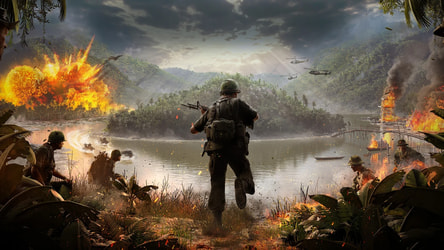
Two teams of 50 fight squad by squad under a commander's orders. Hell Let Loose: Vietnam moves the series' World War II formula into the Vietnam War, with US Armed Forces and the North Vietnamese Army (NVA) contesting river deltas, mountain gorges, flooded lowlands and ports.
Each player takes one role in a squad, and the squad's task is to hold or capture a sector.
Top 3 Reasons to Play
- Maps that look and play differently. Quảng Ngãi is a monsoon-flooded lowland of bamboo forest, cliffs and caves. Đắk Tô Airfield is a long, cratered airstrip with open ground around it. Cam Ranh Port combines dunes and dry creek beds with a deep-water bay and industrial docks.
- Helicopters you fly. They are fully operational for the first time in the series. A pilot can move a squad across the map, resupply a position, look ahead of the front line or attack from the air.
- A war fought on rivers as well. Armed patrol boats are playable for both teams, the US version being the PBR (Patrol Boat, River). Vạn Tường threads a river network through its villages and jungle, with room for boat movement and riverside ambushes.
Story and Lore
The game covers the Vietnam War between 1965 and 1973. There is no single-player campaign or named protagonist. Each of the six maps is inspired by a real episode of the war, without aiming to recreate the battlefield exactly.
- Vạn Tường – Operation Starlite, August 1965. US Marines fought the Viet Cong's 1st Regiment near Chu Lai in the first major offensive fought by an entirely American force.
- Quảng Ngãi – Operation Piranha, September 1965, a follow-up to Starlite on the Batangan Peninsula that went after retreating enemy forces.
- Đắk Tô Airfield – the November 1967 Battle of Đắk Tô in the Central Highlands, where an attack struck a US airfield and the hilltop positions around it.
- Huế Outskirts – the surprise attacks of the January 1968 Tet Offensive.
- Thanh Hóa Bridge – Operation Rolling Thunder (1965–1968), the US bombing campaign. The bridge over the Nam Ma River, nicknamed the Dragon's Jaw, was among the most heavily defended targets of Rolling Thunder.
- Cam Ranh Port – the logistics facility at Cam Ranh Bay, attacked several times, including a sapper attack in August 1969. No single operation is attached to this map.
Gameplay and Mechanics
Both teams split into squads, and command is layered. Squad leaders build garrisons that serve as forward respawn points, while the commander works from a tactical map, marks where resource nodes and garrisons should go, and can call in a recon plane, artillery or air strikes and supply airdrops.
Four modes ship with the game:
- Warfare is a tug-of-war over five sectors, with a single front line pushing toward an enemy HQ.
- Offensive pits attackers against defenders: the attacking side takes points one after another against a timer.
- Conquest keeps several points contested at once. Each team has a shared morale pool that drains as players redeploy and as points are lost.
- Domination asks teams to hold central points, which opens the enemy HQ to capture.
On foot, players can swim, climb and crawl, and a wounded teammate can be dragged out of the line of fire and healed. Weapons follow the period: the M16A1, M60 machine gun and M79 grenade launcher on the US side, the RPD machine gun and RPG-2 launcher for the NVA. A revamped tutorial and an updated interface ship with the game.
Characters and Factions
The game has two playable sides and no named cast. A player's identity comes from faction and role.
- US Armed Forces. Helicopter units belong to this side alone, and they account for two of the roles.
- North Vietnamese Army (NVA). Tunnel networks are exclusive to this side. Commanders and squad leaders link them to garrisons, and enemy players can destroy any tunnel they find.
Seventeen roles are spread across six units: one in Command, seven in Infantry, two each in Recon and Armour, two in Helicopter and three in the Mortar Squad. Armour units crew the tanks, and the Mortar Squad handles indirect fire.
Editions
Two editions exist:
- Standard Edition – the base game.
- Deluxe Edition – the base game plus the 2026 Field Supplies, uniform packs released in stages during 2026 (ANZAC & NVA and Green Berets & Navy SEALs), and the NVA Boat Crew Uniform.
Two uniforms are sold separately, the US Army Boat Crew Uniform and the NVA Boat Crew Uniform, and the Helicopter Survival Vest & SPH-4 Patriot is a free add-on. Steam also lists a bundle that pairs the game with the original Hell Let Loose.