


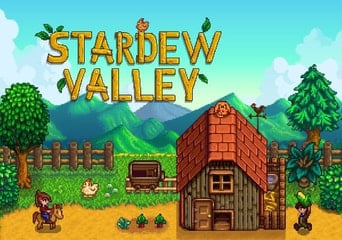


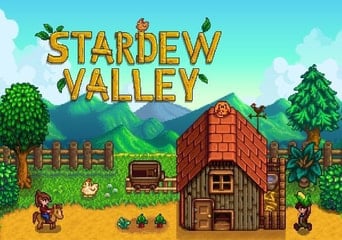


Stardew Valley
Stardew Valley starts off with the player's grandfather leaving them a rundown farm on the edge of Pelican Town, plus a note about what really matters in life, and that's the whole premise. Eric "ConcernedApe" Barone built it alone, design, writing, music, and code, over four and a half years before releasing the game on February 26, 2016. By its tenth anniversary in February 2026, it had sold more than 50 million copies worldwide. The farm itself is the throughline: clearing overgrown fields, planting, expanding, plot by plot. But just as much time goes into fishing, mining through caves that regenerate on every visit, foraging in the woods and along the beach, cooking, crafting, and getting to know, or falling for, the people who live in the valley.
Top 3 Reasons to Play
- Eight farm layouts - The Standard Farm is the wide-open default, but seven other layouts push a save toward something different. Riverland breaks the land up with ponds for fishing. Forest comes with renewable hardwood stumps for foraging. Hill-top has its own ore-bearing quarry built in. Wilderness lets monsters wander onto the property after dark, which is annoying until you realize it's a free combat experience. Four Corners splits into four themed quadrants, clearly built with multiplayer in mind, and Beach trades tillable soil for ocean forage instead. Meadowlands, added in the 2024 1.6 update, hands you a coop and two chickens on day one if animal-first is the plan.
- Multiplayer built for eight, not just four - The 1.6 update bumped the PC multiplayer cap from four players to eight, so a single save on Steam or GOG can turn into a proper crowd. Consoles are still stuck at four, except for the Nintendo Switch 2 version released in late 2025, which supports up to eight players online and throws in local split-screen co-op plus mouse controls the original Switch never got. Whoever creates the world stays the host; everyone else joins as a farmhand, working the same land and chasing the same community goals.
- Twelve marriage candidates open to any player - None of the twelve eligible bachelors and bachelorettes are locked to a particular gender for the player character. Courting Abigail, Sebastian, or anyone else plays out the same no matter who the farmer is. If romance isn't the point, befriending Krobus, a shadow-dwelling shopkeeper in the sewers, and asking him to move in as a roommate works just as well. Barone has kept expanding the cast for free, years after launch, and has confirmed a 1.7 update is coming with two more marriage candidates, Clint and Sandy, though there's still no release date.
Story and Setting
The opening cutscene doesn't waste time: a burned-out cubicle job at the Joja Corporation ends the day a letter arrives from a grandfather who left behind his old farm, on the condition that someone actually works it. Pelican Town turns out to be a small community built around one big choice. Rebuild the town's dilapidated Community Center by donating specific items to its Junimo-guarded bundles, or buy a JojaMart membership for 5,000g and let the store manager, Morris, handle the same civic upgrades for cash. Finish the Community Center, and JojaMart shuts down for good; its empty lot eventually becomes a movie theater. The Joja route flips that: buy the membership, and the Community Center itself gets turned into a Joja Warehouse. Either way, one save can't do both.
There's a calendar running underneath all of this too. Each of the four seasons lasts 28 days and ends with a town festival: the Flower Dance in spring, the Luau in summer, the Stardew Valley Fair in fall, the Feast of the Winter Star once it's cold enough to need one. Miss a festival and it's gone for the year. Once the valley itself starts feeling small, there's more: Ginger Island, added in the 1.5 update, has its own farmable plot, a Volcano Dungeon that rearranges itself on every visit, and a handful of new NPCs to meet. The Skull Cavern under the mountain is the real endgame though, a much harder and nearly bottomless dungeon crawl for anyone still chasing rare ore long after the main story is done.
Gameplay and Mechanics
The day-to-day loop is simple at first and expands as the farm grows: till soil, plant whatever's in season, water it by hand or with sprinklers, then sell the harvest through the shipping bin or at Pierre's General Store. Five skills track that loop separately: Farming, Mining, Foraging, Fishing, and Combat, each going up to level 10 with profession choices locked in at levels 5 and 10 that stick for the rest of the save. Tools don't level up on their own. You take them to Clint's Blacksmith and pay in ore, bars, and gold to move from copper to steel to gold to iridium, each tier covering more ground and burning less stamina per swing.
- Mining and combat share the mines under the mountain, which regenerate completely every time you go down. Monsters, ore veins, and geodes stack up across floors reached by an elevator that unlocks every five levels, and combat leans on melee weapons, slingshots, and enchanted rings instead of anything resembling a class system.
- Fishing turns into its own little minigame: cast, then keep a bar chasing the fish icon before it swims off. Better rods add tackle slots for bait that targets specific fish, which matters once you're after something like sturgeon, catfish, or walleye.
- Coops and barns hold chickens, cows, goats, sheep, pigs, and rabbits. Each one's output improves with how happy the animal is and how high the player's Farming level sits, and pigs in particular dig up truffles that feed into the pricier end of cooking and artisan goods.
- Cooking recipes come from TV broadcasts, gifts, and Community Center rewards, turning crops and foraged items into food that restores energy and health. Crafting covers a lot more ground, from sprinklers and scarecrows to kegs and preserves jars that turn raw crops into artisan goods worth more than the crop itself.
- Mods run through SMAPI, a community-built loader downloaded from Nexus Mods since there's no Steam Workshop integration. The 1.6 update rewrote a lot of the game's underlying code to make modding less painful, which is part of why the scene is still this active a decade in.
Editions and Platforms
Stardew Valley has no Standard or Deluxe edition, no season pass, nothing extra to weigh against the base game. The platform underneath it is what actually changes. Steam and GOG share the same PC build and multiplayer backend, so players on either storefront can farm together on one save, and the GOG copy comes DRM-free on top of that. Xbox keys go through the Microsoft Store, with Xbox achievements and cloud saves tied to a Microsoft account. Nintendo's a bit more split: the original Switch tops out at four multiplayer players like every other console, while the newer Switch 2 version, out since December 2025, bumps that to eight online and adds local split-screen co-op plus mouse controls the original Switch never got. Whichever key you end up with, none of the console versions can join a session with a different platform family, or with PC.