





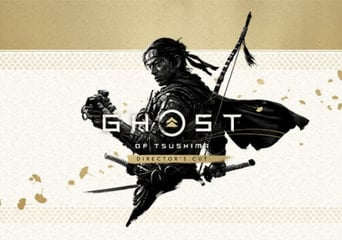


Ghost of Tsushima
Sucker Punch Productions' open-world action-adventure is set during the first Mongol invasion of Japan in 1274. You play Jin Sakai, a samurai who survives the opening massacre on Tsushima Island and slowly trades the honorable fighting his uncle taught him for ambushes, stealth and poison. The game launched on PlayStation 4 on July 17, 2020. The Director's Cut, with the Iki Island expansion, came to PS4 and PS5 in August 2021 and to PC (Steam and Epic Games Store) on May 16, 2024.
Top 3 Reasons to Play
- Regular enemies die in a few clean cuts, and Jin can go down just as quickly, so even a fight with four bandits on a road feels risky. You can also walk up to a camp and challenge one guard to a Standoff, a one-strike duel Sucker Punch took from the final scene of Akira Kurosawa's Sanjuro.
- There's barely any HUD. When you need directions, a swipe on the touchpad (or one key on PC) sends the Guiding Wind through the grass toward your objective. Yellow birds lead you to nearby secrets, and each area has one color it leans on hard, like the orange and yellow maples of the Golden Forest.
- The Director's Cut comes with a second story on Iki Island, about Jin's childhood and his father's death. It also includes Legends, an online co-op mode that drops the historical setting in favor of demons and spirits from Japanese folklore.
Story and Lore
A Mongol fleet led by Khotun Khan lands at Komoda Beach. The Khan is fictional, written as a cousin of Kublai Khan and a grandson of Genghis, and he'd rather take the island through fear than lose soldiers taking it. Tsushima's samurai ride out under the jitō, Lord Shimura, and his nephew Jin. Almost all of them are killed on the sand. Shimura ends up a prisoner, and Jin is found half-dead by Yuna, a thief who drags him to safety.
Jin tries to rescue his uncle from Castle Kaneda almost right away and gets thrown off a bridge by the Khan for his trouble. Samurai are taught to face an enemy openly and give their name before a duel. The Mongols fight with bombs, massed archers and hostages, and Yuna has no patience for tradition. With her help, Jin starts killing from the shadows, and the villages he frees begin talking about a vengeful spirit they call the Ghost. Shimura hears the same stories and can't accept them.
The campaign has three acts. Each one moves the war to a new part of the island, starting with Izuhara in the south, then central Toyotama, and finally the snowy north of Kamiagata. A duel at the very end of the main story gives you one last decision, and it determines how Jin's arc closes.
From Act 2 on, you can also sail to Iki Island. A Mongol shaman called the Eagle, Ankhsar Khatun, is spreading a drug her tribe calls "sacred medicine," and Iki is where Jin's father Kazumasa died fighting local raiders while Jin watched as a boy. Once the Eagle doses Jin, his father and his old failures keep showing up in front of him mid-mission.
The invasion really happened, and a Sucker Punch team visited Tsushima twice with a historian. The people are made up, though, and the studio took some liberties on purpose. Jin's armor follows Sengoku-period designs from about three hundred years later, and the poetry side activity uses haiku instead of the waka of the period because players outside Japan actually know the word.
Gameplay and Mechanics
Jin picks up four combat stances by spying on or killing Mongol leaders. Stone is for swordsmen, Water for shield bearers, Wind for spearmen and Moon for the big brutes, and switching mid-fight to match whoever is attacking is most of the skill. Parries and heavy blows break guards. Parrying and killing also build Resolve, which you spend on healing or special techniques. After a streak of kills without taking a hit, or after butchering a leader, Ghost Stance kicks in and every strike kills. The game has no lock-on button, so crowd fights are about footwork and camera control.
For stealth, Jin gets a tanto for silent kills and eventually learns to chain them across several guards. His Ghost weapons cover the rest:
- Wind chimes and firecrackers to draw guards away
- Smoke bombs for escapes
- Kunai to hit several enemies with one throw
- Sticky bombs and black powder bombs for groups
- A blowgun whose darts make enemies attack their own
Lean on those tools long enough and the weather on Tsushima gets darker and stormier.
The collectibles do real work. Soaking in a hot spring adds health, and cutting through a Bamboo Strike adds Resolve. Climbing to a Shinto shrine past a line of torii gates earns a charm with a passive perk. Following a fox to an Inari shrine gives you another charm slot. Haiku spots and Pillars of Honor are purely cosmetic, handing out headbands and sword kits.
Every armor set carries its own perks, and you upgrade them with materials picked up across the island. Some of the best come from Mythic Tales, legends that a musician named Yamato sings for Jin before sending him off to find the gear himself. Gosaku's Armor and the Kensei Armor are both earned this way. Difficulty goes from Easy up to Lethal, a post-launch setting where Jin's katana and enemy blades both hit harder and the parry window shrinks. Kurosawa Mode turns the whole game black and white, with film grain and older-sounding audio.
Legends plays as online co-op with four classes: Samurai, Hunter, Ronin and Assassin. Two players can take on the story missions, and four-player squads get survival (15 waves of enemies) and the three-chapter Tale of Iyo raid. Rivals pits two duos against each other: kills earn Magatama, which each team spends on curses that slow the other side down. Your gear's Ki level decides which difficulty you can realistically survive. Back in the single-player game, beating the story opens New Game+ for a tougher second run with your gear intact.
Characters and Factions
Jin Sakai (voiced by Daisuke Tsuji in English) is the last of Clan Sakai. His uncle, Lord Shimura, raised him after his father died, and the two share a belief in the samurai code right up until the war forces Jin to break it.
Most of Jin's allies come with a long side story of their own. Yuna saves his life and teaches him to fight without rules, and her younger brother Taka, a blacksmith, builds the grappling hook Jin uses to climb castle walls. Lady Masako Adachi, recently widowed, is hunting the people behind her family's murder. Sensei Ishikawa is a master archer chasing a former student who went over to the Mongols. Kenji sells sake and runs small-time scams, Norio is a warrior monk, and Ryuzo, a childhood friend, leads the Straw Hat ronin.
Khotun Khan (Patrick Gallagher) has studied Japanese culture closely and knows how to use the samurai's own customs against them. On Iki Island, Jin faces Ankhsar Khatun and her Eagle Tribe, and has to work with raiders who have no love for anyone named Sakai. Legends is framed by Gyozen, a storyteller who presents every mission as one of his tales.
Editions
On PS4 the game originally shipped in four versions: Standard, Digital Deluxe, and the physical Special and Collector's Editions. The Digital Deluxe extras later became part of the PlayStation Director's Cut:
- Hero of Tsushima Skin Set (armor, golden mask, sword kit, saddle and horse)
- Charm of Hachiman's Favor and one extra Technique Point
- Digital mini art book and director's commentary
Director's Cut (PS4 and PS5) has the full game, Iki Island, Legends and those Digital Deluxe items. The PS5 version runs at dynamic 4K targeting 60 fps and supports DualSense haptics and adaptive triggers, 3D audio and Japanese lip sync. It can also import a PS4 save. If you already own a PS4 copy, there's a paid upgrade path to the PS5 version.
Director's Cut (PC) is the only version sold on Steam and the Epic Games Store, and it includes the full game, Iki Island and Legends. Nixxes Software handled the port, which has unlocked frame rates, DLSS 3, FSR 3 and XeSS, ultrawide support (21:9, 32:9 and 48:9 triple-monitor setups), and full DualSense features over a cable. You only need a PlayStation Network account for Legends and the PlayStation overlay, though linking one also gives you a few bonus items. Since an October 2025 patch, Legends installs as a separate free DLC.