

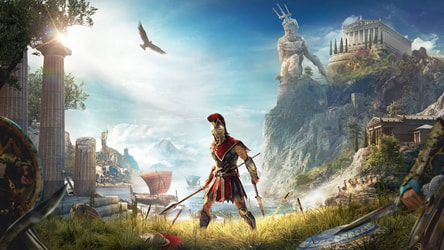


Assassin's Creed Odyssey
Athens and Sparta are at war, and the Aegean is the battlefield. Assassin's Creed Odyssey casts the player as a mercenary who can pick a side, switch sides or ignore the conflict while chasing a family mystery across Greece. Alexios and Kassandra are both selectable as the lead, and the game keeps the level-and-loot structure that Origins introduced to the series.
It launched in October 2018 and takes place in the opening years of the Peloponnesian War.
Top 3 Reasons to Play
-
The war is playable from either side. Conquest Battles let the player join Sparta or Athens in exchange for gear.
-
Medusa and the Minotaur show up in side quests, recast as monsters corrupted by artifacts from the series' First Civilization.
-
The choice of Alexios or Kassandra defines the lead, while dialogue options reshape quests and their outcomes. Ubisoft cites more than 30 hours of choice-driven dialogue and multiple endings.
Story and Lore
A prologue at Thermopylae in 480 BCE introduces the lead's ancestry. The main story begins decades later, in the first years of the Peloponnesian War, with the lead exiled from Sparta, working as a mercenary and descended from King Leonidas. Ubisoft frames the setting as Greece at the height of its Golden Age, with Sparta and Athens on the brink of a long war.
The search for the lost family leads into the Cult of Kosmos, a secret network with members placed in power on both sides of the war, among them the Athenian leader Kleon and the Olympic judge Kallias. Dismantling it takes the lead across the mainland and the islands of the Aegean.
A second thread belongs to Layla Hassan, the modern-day Assassin from Origins. She follows the memories through the Animus while looking for Atlantis and the Staff of Hermes Trismegistus, an artifact left by the First Civilization.
Two expansion arcs push that mythology further. Legacy of the First Blade, released on December 4, 2018, introduces Darius, the first wielder of the Hidden Blade, and a new enemy tied to the order that later troubles Bayek in Origins. The Fate of Atlantis followed on April 23, 2019, and moves the story into Elysium, the Underworld and Atlantis itself, with the Isu playing a larger role than in earlier games.
Gameplay and Mechanics
Odyssey runs on an MMO-style level system. Enemies several levels above the player are very hard to beat, and some story quests unlock only at higher levels, which pushes players toward side activities between main missions. At the start the player picks Guided mode, which keeps the usual map icons, or Exploration mode, which removes them and offers directions to locations instead.
Combat is organized into Warrior, Hunter and Assassin ability branches. Normal attacks build adrenaline that powers four active abilities, among them the early Sparta Kick, which knocks enemies backward and can send elite targets off a ledge. Gear can be upgraded at a blacksmith to the player's current level, and engravings add buffs such as extra warrior damage or extra damage against Spartans; rare and legendary pieces hold more of them. A completed legendary armor set upgrades together. Enemies have a fire buildup stat, and it takes several hits to set one alight.
- Naval combat: the ship fights from Black Flag return in a simplified form. The Adrestia can be rowed for precise movement or sailed for speed, and combat covers ramming, archers, javelin throwers and boarding. Ship upgrades cover damage, armor and appearance, and up to four lieutenants add bonuses; they are recruited by knocking out enemy captains rather than killing them.
- Mercenaries: 39 partly procedural mercenaries roam the world in nine ranked tiers. They chase the bounty on the player's head, which can be cleared by paying drachmae or killing whoever placed it. Unlike the nemesis system in Shadow of Mordor, they do not build up personalities over repeated meetings, though some unique ones drop legendary gear or engravings.
- Conquest Battles: control of a region is worn down by killing soldiers, stealing the treasury or burning supplies. Once a faction's grip is nearly gone, a battle opens with up to 150 soldiers per side, according to Ubisoft. Attacking brings a harder fight and better loot, while defending is easier with smaller rewards.
- Ikaros: the eagle marks enemies, treasure and points of interest, though he cannot be used underground.
Dialogue options affect quests, allegiances and romance options, and the choice of Alexios or Kassandra does not change the main story. Two modes sit outside the campaign: Story Creator Mode provides a quest editor with branching dialogue whose finished stories can be shared and played by others, and Discovery Tour: Ancient Greece removes the plot and turns the map into a guided museum.
Characters and Factions
- Kassandra and Alexios: the two playable leads. Kassandra is treated as the series' canon protagonist.
- Nikolaos: a Spartan general known as the Wolf of Sparta.
- Myrrine: the lead's mother, central to the family mystery.
Barnabas, a naval captain, hands over the ship Adrestia, and the historian Herodotos lends help at Delphi. Athens brings in the statesman Perikles and his partner Aspasia, while the Spartan side includes the general Brasidas and the kings Archidamos and Pausanias.
Athens and Sparta are the two warring powers, one built on its navy and the other on its army. The Cult of Kosmos places members in each camp, among them the priestess Chrysis and Silanos, the ruler of Paros.
Editions
- Standard Edition: the base game.
- Deluxe Edition: the base game with the Kronos Gear Pack, the Herald of Dusk Gear Pack, the Capricornus Naval Pack and temporary XP and drachma boosters.
- Gold Edition: the base game plus the Season Pass, which covers The Secrets of Greece quest, Legacy of the First Blade and The Fate of Atlantis (episode details are under Story and Lore).
- Ultimate Edition: everything in the Gold Edition together with the Deluxe Edition content.