
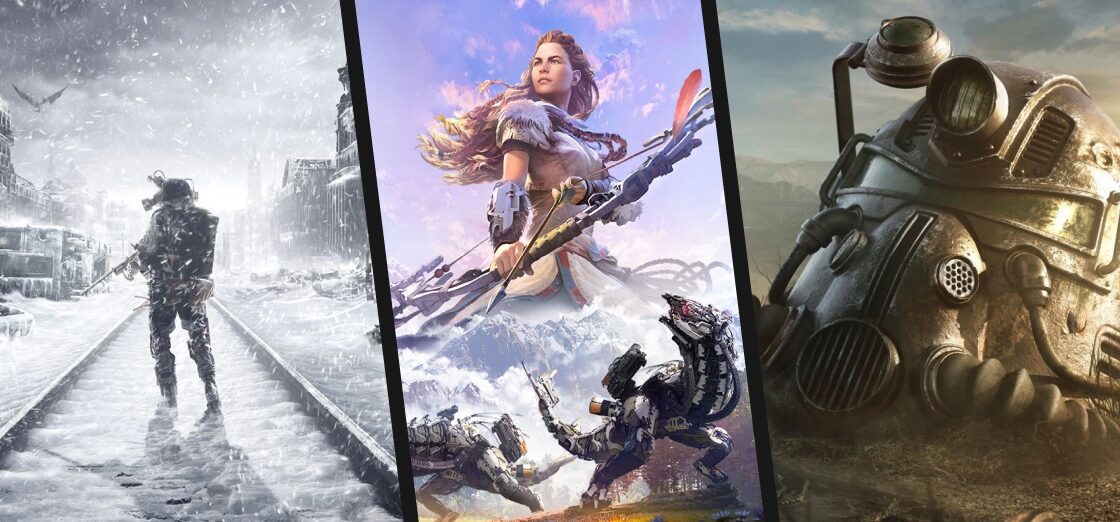
There’s something captivating about exploring worlds where civilization has crumbled and humanity clings to survival. Post-apocalyptic games offer players the chance to navigate desolate landscapes, make morally complex decisions, and experience stories of resilience against impossible odds. Here’s our list of our favourite games set in post-apo settings.
- The Last of Us: Redefining zombie survival
- Metro: Underground survival horror
- The Walking Dead: Choice-driven storytelling
- Horizon Zero Dawn: Nature reclaims technology
- Fallout: The wasteland that started it all
- Frostpunk: City-building in eternal winter
- DayZ: Multiplayer survival chaos
- Wasteland: The tactical RPG origins
- Build your post-apocalyptic gaming library with GAMIVO
The appeal of post-apocalyptic gaming extends far beyond simple destruction. These games explore themes of hope, loss, community, and the human spirit’s remarkable ability to adapt. Whether you’re scavenging for resources in a nuclear wasteland or building settlements from the ruins of the old world, each title offers a unique perspective on humanity’s potential futures.
From zombie-infested cities to frozen tundras where survival depends on steam-powered technology, the variety of post-apocalyptic scenarios in gaming is staggering. Some focus on intimate character-driven narratives, while others emphasize large-scale city building or intense multiplayer survival. The common thread connecting them all is the fundamental question: what would you do if the world ended tomorrow?
This comprehensive guide explores the essential games that define the post-apocalyptic genre, each offering distinct gameplay mechanics, storytelling approaches, and atmospheric experiences that will keep you engaged for hours.
The Last of Us: Redefining zombie survival
Naughty Dog’s masterpiece stands as perhaps the most emotionally resonant entry in the post-apocalyptic gaming canon. Set twenty years after a fungal infection transforms most of humanity into zombie-like creatures called “infected,” The Last of Us follows Joel and Ellie’s journey across a beautifully rendered American wasteland.
The game’s greatest strength lies in its character development. Joel, a hardened survivor haunted by personal loss, reluctantly escorts Ellie, a teenager who might hold the key to humanity’s salvation. Their relationship evolves organically throughout the journey, creating genuine emotional stakes that elevate the experience beyond typical zombie fare.
Combat in The Last of Us emphasizes stealth and resource management over action. Ammunition is scarce, forcing players to carefully consider each encounter. The infected enemies range from recently turned “runners” to the terrifying “clickers” that hunt purely by sound. This variety keeps encounters tense and unpredictable.
The game’s environmental storytelling is exceptional. Abandoned cities slowly being reclaimed by nature tell wordless stories about civilization’s collapse. Museums, schools, and homes contain remnants of the world that was, creating a melancholy atmosphere that permeates every moment of exploration.
The popularity of the game resulted in creating the The Last of Us series on HBO. This work received dozens of positive reviews
Metro: Underground survival horror
Based on Dmitry Glukhovsky’s novels, the Metro series transports players to the Moscow subway system, where survivors huddle in underground stations after nuclear war devastates the surface. These games blend survival horror with first-person shooting, creating a uniquely claustrophobic and atmospheric experience.
Metro 2033, Metro: Last Light, and Metro Exodus each contribute different elements to the series’ evolution. The first two games confine players to the tunnels beneath Moscow, where different stations have developed their own cultures and political systems. The cramped environments and limited resources create constant tension.
The series’ attention to environmental detail is remarkable. Gas masks fog up and crack, requiring constant maintenance. Ammunition doubles as currency, forcing players to balance firepower with economic needs. The lighting system uses actual light sources, making your flashlight and lighter crucial survival tools.
Metro Exodus breaks from the underground setting, taking players across post-nuclear Russia via train. This shift allows for more varied environments while maintaining the series’ commitment to atmospheric storytelling and resource scarcity. The game’s day-night cycle and dynamic weather systems add layers of strategic planning to exploration and combat.
Each Metro game emphasizes moral choices that affect both story outcomes and gameplay mechanics. These decisions rarely have clear right or wrong answers, reflecting the moral ambiguity inherent in survival situations.
The Walking Dead: Choice-driven storytelling
Telltale Games’ adaptation of The Walking Dead comic series prioritizes narrative decision-making over traditional gameplay mechanics. Players control Lee Everett, a convicted murderer who becomes the unlikely protector of young Clementine during the zombie apocalypse’s early days.
The game’s episodic structure creates natural pacing that builds tension and allows for character development. Each episode presents players with difficult moral choices, often with time limits that prevent overthinking. These decisions shape both story outcomes and character relationships in meaningful ways.
Clementine’s character arc across multiple seasons represents one of gaming’s most compelling coming-of-age stories. Players watch her evolve from innocent child to hardened survivor, with player choices influencing her moral development and worldview.
The cel-shaded art style perfectly captures the comic book aesthetic while allowing emotional expressions to shine through. Voice acting performances, particularly from Dave Fennoy (Lee) and Melissa Hutchison (Clementine), bring depth and authenticity to every conversation. Combat sequences, while minimal, focus on quick-time events and point-and-click interactions rather than traditional action mechanics. This approach keeps the focus on story and character development while maintaining tension during zombie encounters.
Horizon Zero Dawn: Nature reclaims technology
Guerrilla Games created something special with Horizon Zero Dawn—a post-apocalyptic world where robotic creatures roam lands reclaimed by nature. Set 1,000 years after civilization’s fall, the game follows Aloy, a hunter seeking to uncover the truth about the world’s mysterious past.
The game’s unique hook lies in its fusion of primitive and advanced technology. Aloy uses bows, spears, and traps to hunt massive mechanical beasts, each requiring different strategies to defeat. The contrast between tribal societies and ancient technological ruins creates a visually striking and thematically rich world.
Combat encounters feel like elaborate puzzle-solving exercises. Each machine type has specific weak points and behavioral patterns. Players must study their prey, craft appropriate ammunition, and execute precise attacks to succeed. This strategic approach makes every encounter feel earned rather than button-mashed.
The world-building gradually reveals how advanced AI attempted to preserve life after environmental collapse, only to create new problems for future generations. Ancient audio logs and holographic recordings piece together a story of corporate greed, environmental destruction, and humanity’s attempts at redemption.
Horizon’s approach to the post-apocalyptic genre feels refreshingly optimistic. Rather than focusing solely on humanity’s capacity for destruction, it explores themes of renewal, learning from past mistakes, and the resilience of both nature and human spirit.
Fallout: The wasteland that started it all
No discussion of post-apocalyptic gaming is complete without Fallout, the series that helped define the genre’s tropes and continues to influence games decades later. Set in an alternate timeline where nuclear technology advanced rapidly, the Great War of 2077 left America as a radioactive wasteland.
The original Fallout games (1997’s Fallout and 1998’s Fallout 2) established the series’ signature blend of dark humor and serious social commentary. These isometric RPGs emphasized player choice, with multiple solutions to most problems and consequences that rippled throughout the game world.
Bethesda’s acquisition of the franchise brought us Fallout 3, Fallout: New Vegas, and Fallout 4, each expanding the formula in different directions. Fallout 3’s transition to first-person perspective opened up new possibilities for exploration and combat while maintaining the series’ commitment to player agency.
Fallout: New Vegas, developed by Obsidian Entertainment, represents the series’ storytelling peak. The game presents a complex political situation in post-war Nevada, where multiple factions vie for control of New Vegas and the Mojave Desert. Player choices carry significant weight, with multiple ending variations reflecting different philosophical approaches to post-war governance.
The V.A.T.S. (Vault-Tec Assisted Targeting System) combat system bridges the gap between real-time action and turn-based strategy, allowing players to pause time and target specific body parts. This system maintains tactical depth while accommodating different play styles. Fallout’s cultural impact extends beyond gaming, influencing how we visualize post-nuclear scenarios and introducing iconic imagery like Vault Boy and the distinctive retro-futuristic aesthetic mixing 1950s optimism with apocalyptic dread.
Frostpunk: City-building in eternal winter
11 bit Studios’ Frostpunk tackles post-apocalyptic survival from a city-building perspective, challenging players to manage the last human settlement during a global ice age. The game forces difficult decisions about resource allocation, social policies, and moral compromises necessary for survival.
The central heat generator becomes both a practical necessity and powerful symbol. Citizens gather around this life-giving technology, but keeping it operational requires constant fuel and maintenance. Managing heat distribution across expanding settlements creates strategic challenges that grow more complex over time.
Frostpunk’s genius lies in its moral complexity. Players must balance immediate survival needs against long-term social health. Do you implement child labor to gather resources faster? Will you allow overcrowding in shelters to save more lives? Each decision shapes both your city’s efficiency and its moral character.
The game presents scenarios inspired by different leadership philosophies. The Order path emphasizes discipline and hierarchy, while Faith focuses on hope and community bonds. Neither approach is inherently good or evil—both can lead to either salvation or tyranny depending on player choices.Random events constantly test your settlement’s stability. Refugee arrivals strain resources while providing needed manpower. Equipment failures threaten vital systems. Food shortages force difficult rationing decisions. These challenges prevent the game from becoming a simple optimization puzzle.
DayZ: Multiplayer survival chaos
DayZ began as a mod for military simulation game ArmA 2 before becoming a standalone survival game that helped define the multiplayer survival genre. Set in the fictional post-Soviet republic of Chernarus during a zombie outbreak, DayZ strips away traditional gaming conveniences to create a brutally authentic survival experience.
The game’s most compelling feature is its complete lack of traditional objectives. Players spawn on the coast with minimal equipment and must scavenge for food, water, weapons, and medical supplies while avoiding both zombies and other players. This emergent gameplay creates unique stories that arise naturally from player interactions.
Trust becomes DayZ’s most valuable and dangerous currency. Other players can provide assistance, trade resources, or share information—but they can just as easily rob, betray, or kill you for your supplies. This uncertainty creates constant tension that few games can match.
The medical system adds layers of complexity to survival. Injuries require appropriate treatment, illnesses spread between players, and blood loss affects performance. This attention to biological realism makes every encounter potentially life-threatening in unexpected ways.
DayZ’s massive map encourages exploration and creates opportunities for different survival strategies. Coastal areas offer easier scavenging but attract more players. Inland regions provide better loot but require more preparation to reach safely. Military bases contain the best equipment but represent the highest-risk locations.
Wasteland: The tactical RPG origins
The Wasteland series deserves recognition as one of the post-apocalyptic genre’s founding franchises. Released in 1988, the original Wasteland established many conventions later adopted by games like Fallout. The recent Wasteland 2 and Wasteland 3 modernize these concepts while maintaining the series’ tactical combat focus.
Wasteland games emphasize squad-based gameplay, requiring players to manage multiple characters with different skills and specializations. This approach creates more tactical depth than single-character adventures, as positioning and coordination become crucial to success.
The series maintains a darkly humorous tone while tackling serious themes about civilization’s collapse and reconstruction. Characters encounter bizarre situations arising from humanity’s attempts to rebuild society without fully understanding the technology and knowledge lost during the apocalypse.
Skill systems in Wasteland games reward specialization and cooperation. Characters might specialize in different weapon types, technical skills, or social abilities. Success often depends on having the right specialist for specific challenges, encouraging diverse team composition.
Wasteland 3’s Colorado setting introduces environmental hazards like blizzards and frozen landscapes that affect both exploration and combat. The game’s vehicle system allows for mobile bases and mounted weapons, adding new strategic options to encounters.
Build your post-apocalyptic gaming library with GAMIVO
These games showcase diverse approaches to post-apocalyptic storytelling and gameplay, each offering a unique vision of humanity’s potential futures. From the intimate character drama of The Last of Us to the expansive world exploration of Fallout, the claustrophobic tension of Metro, or the optimistic renewal in Horizon Zero Dawn, there’s something for everyone. Whether you prefer story-driven experiences like Telltale’s The Walking Dead or strategy challenges like Frostpunk’s city-building, these titles cater to a range of gaming preferences. The beauty of this genre lies in its ability to explore universal themes through different lenses—zombie survival, nuclear fallout, climate change, or technological collapse.
And the best part? You can find all these incredible games at great prices on GAMIVO. Dive into these virtual wastelands and explore the deeper questions about humanity, morality, and resilience, all while enjoying an unbeatable deal!


Stranger Than Heaven: release date, story and gameplay explained
RGG Studio’s next Yakuza game finally has a release date. Stranger Than Heaven takes us back to 1915 with a cast that mixes Japanese TV stars with Snoop Dogg, Tori Kelly and Ado. Here’s everything we know so far about the story, cast, editions and gameplay.

Cheapest Place to Buy Steam Keys, and What a Steam Key Really Is
The cheapest place to buy Steam keys is the one with the right key: Steam activation, a matching region, and the edition you want.

Genshin Impact 6th Anniversary: Two Free 5-Stars, 20 Wishes and a lot of rewards in Version 7.1
Genshin Impact turns six with two free 5-stars: a limited pick like Varesa, Clorinde or Childe, plus a standard one like Diluc or Mizuki. Add 20 free wishes and here’s how to claim it all.