
Every Steam sale page looks like a wall of green percentages, but the number on a tag says little on its own. To find the best deals on Steam games, you need the rules behind it: who set the discount, how long it can last, how soon it can come back, and which events bring the widest choice of cut prices.
The best deals on Steam games come from four sources: discounts set by each game’s developer or publisher, curated Daily, Midweek and Weekend Deals picked by Valve, the four Steam-wide seasonal sales, and bundles that charge you only for the games you do not own yet. A Steam discount ranges from 10% to 95% and usually cannot return within 30 days. The next Steam-wide seasonal sale, the Steam Winter Sale 2026, runs from December 17, 2026, to January 4, 2027, according to Valve’s calendar for developers.
This guide explains those rules so you can tell a routine discount from a rare one. Every Steam rule below comes from Valve’s Steamworks documentation for developers, read on September 26, 2026. For wider ways to cut what you spend on games, see our guide on how to save money on PC games.
How do Steam discounts work?
A Steam discount is a temporary price cut of 10% to 95% that a game’s developer or publisher sets in Steamworks. Valve describes Steamworks as “the set of tools and services built by Valve that help you configure, manage, and operate your game on Steam.”
Valve leaves the price cut to the developer: “partners set their own prices and discounts.” Once a developer schedules a self-serve discount, “your game will automatically go on sale at the date and time you specified.”
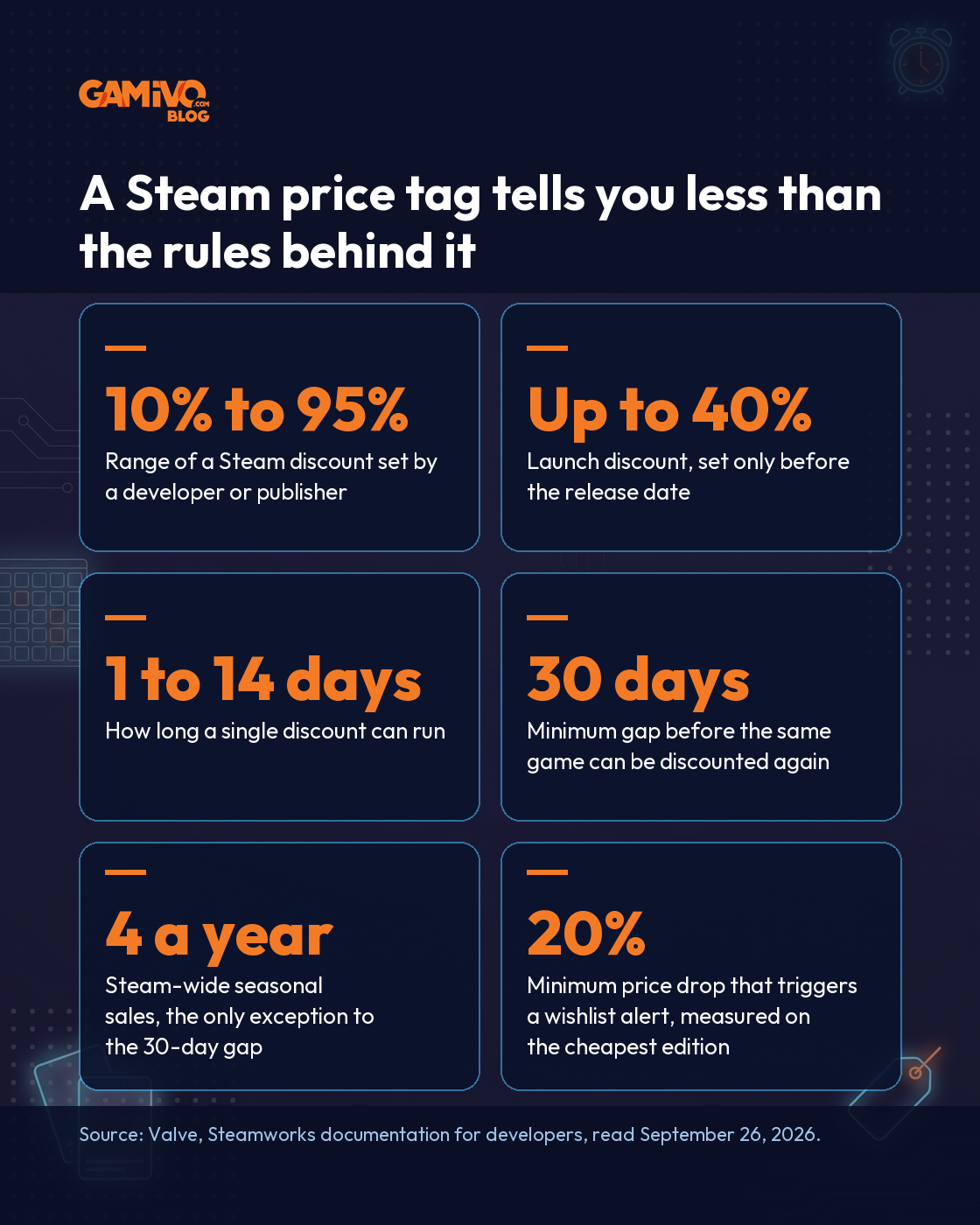
Steam limits how deep and how long a discount can be. According to Steamworks, “It’s not possible to discount a product by less than 10% or more than 95%,” and “Discounts cannot run shorter than 1 day or longer than 14 days.” A new game can open with a launch discount, but “Launch discounts in particular cannot exceed 40%,” and they run for 7 to 14 days.
The 30-day cooldown
The rule that matters most for timing is the cooldown: “A product cannot be discounted within 30 days of another discount.” A 30-day wait also follows a game’s release and any price increase. At release, Steam allows a launch discount, but only if the developer sets it up before the release date. The four Steam-wide seasonal sales are the exception. Steamworks notes that they “do not have 30-day discount cooldowns.”
| Steam discount rule | Limit in the Steamworks documentation |
|---|---|
| Discount depth | 10% to 95% |
| Launch discount depth | Up to 40%, set only before release |
| Discount length | 1 to 14 days (launch discount: 7 to 14 days) |
| Gap between two discounts | 30 days, except the four seasonal sales |
| After release or a price increase | No discount for 30 days, except a launch discount |
What are Daily, Midweek and Weekend Deals on Steam?
Daily, Midweek and Weekend Deals are curated Steam promotions that Valve selects and features on the Steam homepage. A Daily Deal holds its spot for one day: “Daily Deals are featured on the Steam homepage for 24 hours, and rotate every day at 10am Pacific.”
Midweek Deals stay on the homepage “for 72 hours, from Monday at 10am Pacific until Thursday at 10am Pacific,” and Weekend Deals “for 96 hours, from Thursday at 10am Pacific until Monday at 10am Pacific.” There are up to six Midweek and up to six Weekend slots per week.
Developers cannot buy these spots. Valve explains that they “aren’t negotiated for or sold, they’re just built around player data.” Curated slots are also “generally restricted to once a calendar year, with at least three months’ gap between promotions.”
Developers can opt into Weeklong Deals themselves instead of waiting for Valve to pick them. These deals keep a fixed schedule: “Weeklong Deals begin every Monday morning at 10AM Pacific time and run for 7 days.”
When are the big Steam sales in 2026 and 2027?
Steam runs four seasonal sales a year: Spring, Summer, Autumn and Winter. Valve invites all games on Steam “to participate with a discount,” provided the game came out at least 30 days before the start date.
The Steam Autumn Sale 2026 ran from October 1 to 8, 2026. The next seasonal sales announced to developers, as listed on October 12, 2026, are:
| Steam sale event | Dates |
|---|---|
| Steam Winter Sale 2026 | December 17, 2026, to January 4, 2027 |
| Steam Spring Sale 2027 | March 18 to March 25, 2027 |
| Steam Summer Sale 2027 | June 24 to July 8, 2027 |
Between seasonal sales, Steam holds themed events called Fests, each built around a genre or theme, where “discount games are prioritized.” The calendar for fall 2026 lists three Fests:
- Cooking Fest: October 12 to 19, 2026
- Steam Scream V, a horror event: October 26 to November 2, 2026
- Auto-Battler RPG Fest: November 16 to 23, 2026
A discount during a Fest counts toward the 30-day cooldown: Valve’s FAQ lists “Steam Fests, Publisher Sales, and any custom discounts” among the promotions the cooldown applies to. The dates above come from the Steamworks events page, which lists what is “currently announced,” so check them again shortly before each event.
How do Steam bundles work?
A Steam bundle is a group of games, DLC or software offered at a fixed percentage off the items inside it. The discount works item by item: a bundle applies “a discount percentage (defined when creating the bundle) to all of the packages in the bundle not already in the account of the purchasing customer.”
The “Complete The Set” type is the one that rewards existing owners. With it, customers “will pay for, and receive, just the items in that bundle that they don’t already have in their Steam library.” The second type, “Must Purchase Together,” works the opposite way: customers can buy it “only if they do not already have any of the products in the bundle.”
During a sale, a bundle gets cheaper together with its contents. The Steamworks documentation explains that “the bundle is just a specified percentage off the current price of the item.” When a game in the bundle is discounted, “the bundle discount will be applied on top of any individual discounts.” A bundle can take up to 95% off the items it contains.
What does the percentage on a Steam discount refer to?
A Steam discount percentage is calculated from the game’s base price. Valve posts discounts “in reference to a base price that has been in place for at least 30 days,” or to a launch price that stays in place after an introductory offer ends. A developer who raises the price on a Monday therefore cannot discount the game from that new price the following week.
Valve also gives developers advice on timing. It suggests they “ease into discounting,” for example moving “from 33% to 50% to 66% to 75% and beyond over the course of a year or more.” If a game’s publisher follows that advice, a small first discount after launch is normal and deeper ones come later.
The same deal can look different from one country to another. Valve notes: “Discounts may display differently to customers in different parts of the world, per local laws.” In some regions, the crossed-out price does not appear, but you still pay the discounted price.
How do Steam wishlist notifications work?
The Steam wishlist works as a built-in deal alert: when a wishlisted game “releases or goes on discount, those players automatically receive a notification.” For a discount, the notice goes out when the cut is “at or above 20%” and when it covers “the lowest priced package for a game.”
A discount on a deluxe edition alone does not trigger the notice. Players notified about a game “within the last 2 weeks” are on an email cooldown, and bundle discounts “will not notify customers who have wishlisted the products inside a bundle.” During seasonal sales, open your wishlisted games yourself instead of waiting for the email.
Best deals on Steam games at a glance
Steam deals fall into eight types, from custom discounts set by developers to seasonal sales and bundles. The table below sums up the Steamworks rules for each of them.
| Deal type | Who decides | How long it runs | What to know |
|---|---|---|---|
| Custom discount | Developer or publisher | 1 to 14 days | 10% to 95% off; then 30 days before the next discount |
| Launch discount | Developer or publisher | 7 to 14 days | Up to 40% off, only at release |
| Weeklong Deal | Developer or publisher (opt-in) | 7 days | Starts on Mondays at 10 AM Pacific |
| Daily Deal | Valve | 24 hours on the homepage | Chosen from player data; the discount itself runs 7 to 14 days |
| Midweek Deal | Valve | 72 hours, Monday to Thursday | Up to six slots per week |
| Weekend Deal | Valve | 96 hours, Thursday to Monday | Up to six slots per week |
| Seasonal sale | Valve invites all games | Per event | Exempt from the 30-day gap between discounts |
| Bundle | Developer or publisher | No fixed period in Steamworks | Percentage set when the bundle is created; “Complete The Set”: pay only for items you do not own |
Where do game keys fit?
Steam is not the only place to get a Steam game. When you activate a Steam key from another site, the game joins your other games in your Steam library. Our guide on how game key sites work walks through that path from supplier to library.
On GAMIVO, customers can buy Steam keys from suppliers. GAMIVO’s FAQ asks buyers to “use the code on the correct platform or software: Steam, Blizzard, EA App, Ubisoft Connect, or any other, specified in the description,” and adds: “Please, make sure to check the region, language, platform, or any other restrictions on the product page.” To compare key offers with prices on Steam itself, see our guide to the cheapest place to buy Steam keys, and for other platforms, where to buy digital game codes.
A five-point check before you buy on sale
A good Steam deal matches the rules above: the right moment in the sale calendar, a percentage within Valve’s limits, and the cheapest way to complete a collection. These five checks take a minute before you pay, whether you buy on Steam or activate a key bought on another site.
- Check the calendar. A seasonal sale is the only event where a game can return to a discount within 30 days of its last one.
- Read the percentage against the rules. The cap is 95%, and a launch discount stops at 40%.
- Look for a bundle. With “Complete The Set,” you pay only for the items you do not own, and the bundle discount stacks on top of individual discounts.
- Wishlist what you want. A discount of 20% or more on the cheapest edition triggers a notification.
- If you buy a key elsewhere, match it first. Check the platform, region and language on the product page before you pay.
Frequently asked questions
Steam deals and sale dates
The best deals on Steam games come from developer discounts of 10% to 95%, curated Daily, Midweek and Weekend Deals chosen by Valve from player data, the four seasonal sales, and “Complete The Set” bundles that charge only for the games you do not own. Wishlisting a game gets you a notification once its cheapest edition is at least 20% off.
According to the dates Valve had announced to developers as of October 12, 2026, the Steam Winter Sale 2026 runs from December 17, 2026, to January 4, 2027. Next come the Spring Sale from March 18 to 25, 2027, and the Summer Sale from June 24 to July 8, 2027.
Discount rules and other sites
A Steam game can go on sale again only 30 days after its previous discount ends. Valve’s rule reads: “A product cannot be discounted within 30 days of another discount,” and the same wait applies after release and after a price increase. The four seasonal sales are the only exception to the gap between discounts.
Yes, if the bundle is the “Complete The Set” type. You pay only for the items you do not have in your Steam library, with the bundle’s percentage taken off each of them. If one of those items already has its own discount, Steam applies the bundle discount on top of it.
Yes. Sites like Steam are PC launchers with their own library, such as Epic Games, GOG, the EA app, Ubisoft Connect, Battle.net and the Xbox app for Windows. A Steam key bought on another website still activates on Steam, so the game lands in the same Steam library. GAMIVO offers Steam keys from suppliers, and its FAQ asks buyers to check the region, language and platform on the product page. Our guide on how game key sites work explains the process.


The Witcher 3 Remastered: What Changed and What Players Think
The Witcher 3 Remastered launched on 29 September 2026 as a free upgrade for owners. Here’s what changed, what it needs to run and how players and critics reacted.

Aniimo Guide and Free Codes: Everything to Know Before You Start
Aniimo is a free-to-play, open-world creature collector from Pawprint Studio that launched on September 16, 2026. Here is how it plays, whether it counts as gacha, which starter to pick and how its shop and currencies work.