
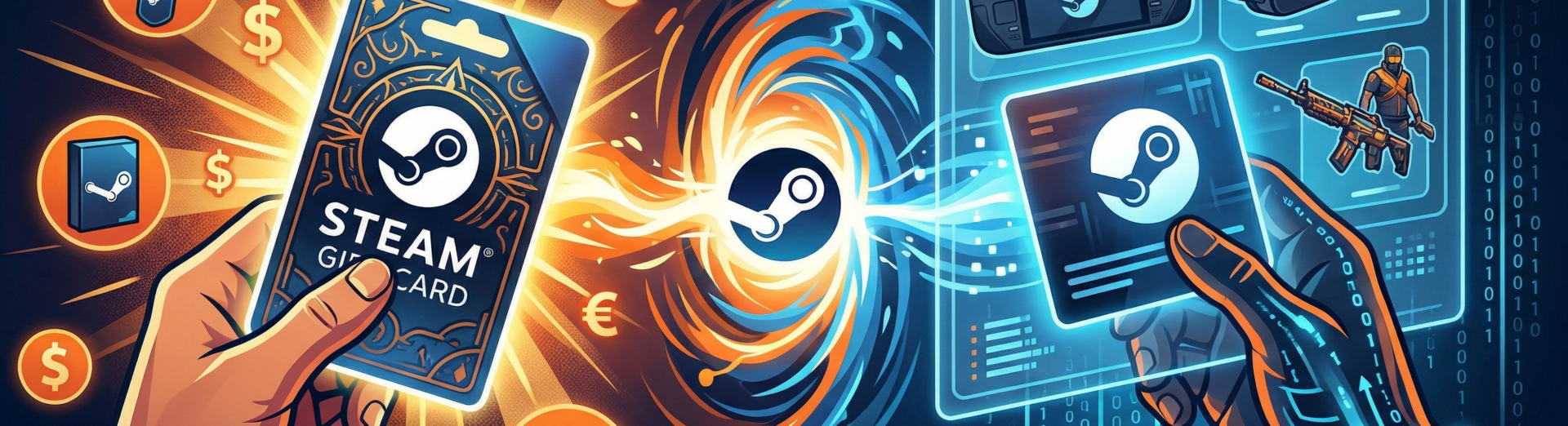
Every gamer has seen the price gap: a title that costs 59.99 EUR in the official store is available for a fraction of that on a game key site. The gap looks mysterious only until you trace the route a key travels – from the publisher’s own systems, through a network of suppliers, to the moment it lands in your library. This article follows that route step by step.
A game key site is an online platform where verified suppliers list activation keys, gift cards, and in-game top-ups, and buyers receive their products digitally – games within minutes, in-game top-ups within half an hour. Keys originate with publishers, who generate them specifically so their games can reach buyers outside official storefronts.
What exactly is a game key?
An activation key is a single-use, unique alphanumeric code that adds a product license to your account on a given platform. That definition comes straight from Valve’s developer documentation – and each platform has its own flavor of the same idea: Steam keys are redeemed in the Steam client, Microsoft uses 25-character codes for Xbox and PC, PlayStation voucher codes run 12 characters, and Nintendo eShop codes have 16.
The key itself carries no game data. It is proof of purchase: once redeemed, the platform links the license to your account and the download begins from the platform’s own servers. This is why a legitimately sourced key activates identically to a store purchase – after redemption you hold the same license and the same game, downloaded from the platform’s own servers.
Where keys come from
Keys do not appear out of thin air – they are generated by the people who made the game. Valve describes Steam keys as a free service for developers, “a convenient tool to help you sell your game on other stores and at retail”. Developers request batches of keys through their publishing dashboard, and Valve reviews each request; standard allocations run up to 5,000 keys per game, with larger batches approved case by case.
Those keys then flow into the retail chain: to digital distributors, wholesale partners, retail promotions, and bundle campaigns. Businesses along that chain buy stock – sometimes in bulk at wholesale rates, sometimes in lower-priced regions, sometimes during deep promotions – and resell it. A key site is where that stock meets the buyer.
One rule from Valve’s documentation is worth knowing because it shows how regulated this channel is: developers who sell keys outside Steam must not leave Steam’s own customers with a worse deal than key buyers receive, and Valve reviews key requests against that standard. Key retail is not a loophole – it is a sanctioned distribution channel with its own rules.
What the platform does in the middle
This is the part most buyers never see, and the part that matters most. On GAMIVO, an e-commerce platform for gamers, the products come from suppliers – and only registered companies are accepted in that role. Before a supplier’s first offer goes live, the business goes through a verification process; the platform’s own materials are explicit that restricting supply to registered, verified companies is what underpins buyer security.
The second thing the platform provides is competition. Unlike an official storefront with its one fixed price, GAMIVO allows many suppliers to list the same product. They undercut each other, and the result is the price gap you see on the offer page – the platform’s own figures speak of discounts reaching 90% off list prices. Turning that gap into real savings is a skill in itself, and our guide to saving money on PC games collects the habits that do it: reading the sale calendar, tracking prices instead of guessing, and comparing key sites before paying full price.
The third layer is the safety net: order statuses you can track, a support team available around the clock, and a refund path – on GAMIVO, you can request a return as long as the key has not been revealed, and the optional Customer Protection Program adds priority handling for problem cases.
From checkout to your library, minute by minute
Here is the full journey on the buyer’s side:
- You pick an offer. Each listing states the platform (Steam, Xbox, PlayStation, Nintendo, Epic, GOG, and others) and the activation region. Checking both boxes before paying is the single most important habit in key buying. When a title comes in several editions, the choice matters too, and our guide on where to buy Minecraft for PC lays out how the editions and their prices compare, so you know which one you want.
- You pay. Once the payment registers, delivery is digital and quick – games typically arrive within minutes, while in-game top-ups can take up to half an hour, because a supplier delivers them to your game account directly.
- You reveal the key. If you have an account on the platform, the code waits in the Purchases section until you choose to display it. That moment matters: an unrevealed key is still returnable; a revealed one is treated as delivered.
- You redeem it. The license attaches to your account and the download starts:
| Platform | Code format | Where to redeem |
|---|---|---|
| Steam | alphanumeric key | Steam client: Games menu, “Activate a Product on Steam” |
| Xbox and PC (Microsoft) | 25 characters | redeem.microsoft.com or Store on console |
| PlayStation | 12 characters | PlayStation Store: Redeem Code |
| Nintendo Switch | 16 characters | eShop: Enter Code |
Why region locks exist
Region locking is the least understood part of the system, and it has a straightforward economic cause: platforms price games differently around the world. Valve’s own pricing documentation describes suggested prices across 37 currencies, calibrated in part to local purchasing power. Publishers sometimes lock keys to regions so a copy priced for one market is not activated in a richer one.
For buyers, the practical rules are simple. A region-locked key activates only in its stated region; PlayStation vouchers must match the region of your account; honest listings always disclose the restriction. One footnote from EU law: the European Commission fined Valve and five publishers 7.8 million EUR in 2021 for geo-blocking activation keys within the European Economic Area – a reminder that regional restrictions inside the single market face legal limits.
More than keys: what else key sites offer
Activation keys were the founding product, but a modern key platform’s catalog is wider: video games and DLC across all major platforms, gift cards – from PlayStation, Xbox, Steam, and Nintendo credit to eGift cards for streaming and shopping services – subscriptions such as PlayStation Plus and Xbox Game Pass, in-game top-ups delivered to your player ID, software, and eSIM products. GAMIVO carries all of these categories, and the delivery logic stays the same throughout: digital, account-based, minutes rather than days.
Top-ups are the category with the most game-specific detail, because every title names its currency differently and sets its own bonus rules. Two guides on this blog cover that ground in full: Garena Free Fire top-ups, where the currency is Diamonds, and Zenless Zone Zero top-ups, where Monochrome, memberships, and the first-purchase bonus reset all come into play.
FAQ
From the same chain that supplies all retail: publishers generate keys and pass them to distributors, wholesalers, and promotional campaigns. Suppliers – registered businesses – buy that stock and list it on platforms such as GAMIVO, where verification and competition between suppliers do the rest.
Technically identical. A key is a code generated by the publisher; once redeemed, the platform grants the same license regardless of where the code was purchased. The differences are commercial – price, delivery method, and support channel – not in the product itself.
On GAMIVO, games and gift cards typically arrive within a few minutes of the payment registering. In-game top-ups can take up to 30 minutes, because the supplier credits your game account directly. The key waits in your account’s Purchases section until you display it.
Yes, with one condition: on GAMIVO, a return can be requested as long as the key has not been revealed. Once you display the code, it counts as delivered – which is why it is best to reveal a key only when you are ready to redeem it.
Because many suppliers compete on one product. They buy stock in bulk, in lower-priced regions, and during promotions, then race each other on price – something an official one-price store never does. Regional price differences, set by the platforms themselves, widen the gap further.
Two fields on every listing: platform and region. The key must match the store you use and the region where your account can activate it. On GAMIVO, both are displayed on the offer and again before the key is revealed.
Sites of this kind work as intermediaries: suppliers list keys sourced from publishers, distributors, wholesalers, and promotional campaigns, while the site itself handles the listings, the payment, and buyer protection. What differs from one site to the next is how thoroughly suppliers are vetted and what happens when a key fails. On GAMIVO, every order is backed by the customer support team, and the Customer Protection Program adds priority handling and faster mediation with the supplier if something goes wrong.

GTA 6. Everything we know so far [Release, editions, and pre-orders]
To say that people were excited about the GTA 6 news would be an understatement. One of the most popular RPG games ever made has finally received its first trailer.

How to Save Money on PC Games by Choosing the Right Edition: Standard, Deluxe or Ultimate
How to save money on PC games: compare Standard, Deluxe and Ultimate editions, season passes, early access and later upgrades before you buy.

GTA Games in Order: The Complete History of Grand Theft Auto
Find out how Grand Theft Auto grew from a 1997 top-down crime game into one of the best-selling franchises ever made. This guide lists all GTA games in order of release and recaps each one: the story, the gameplay, and its impact on the industry.